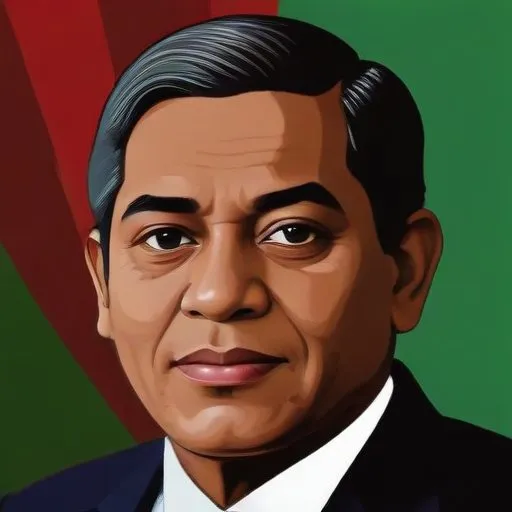
Tajuddin Ahmad: The Architect of Bangladesh's Liberation
The Birth of a Nation
Tajuddin Ahmad was the prime minister of the Provisional Government of Bangladesh, leading the country's fight for independence during the Bangladesh Liberation War in 1971. He is revered as one of the most instrumental figures in the birth of Bangladesh, a nation that emerged from the ashes of British India and Pakistan.
A Life of Politics and Activism
Born on July 23, 1925, Tajuddin began his political journey as a Muslim League youth worker in British India. He belonged to the Dhaka-based pro-democracy, secular Muslim League faction, which broke away from the Muslim League's reactionary party line after the partition of India and the birth of Pakistan. As a member of the short-lived youth organization, the Jubo League, he actively participated in the Language Movement in 1952.
Rise to Prominence
In 1953, Tajuddin joined the Awami Muslim League, later known as the Awami League, a dissident offshoot of the Muslim League. The following year, he was elected a member of the East Pakistan Provincial Assembly. As a close confidante of
Sheikh Mujibur Rahman, he assisted in revitalizing the Awami League into a secular political party during
Ayub Khan's regime in the late 1960s.
The Catalyst for Change
As the General Secretary of the Awami League from 1966, Tajuddin coordinated the party during the tumultuous late 1960s and early 1970s, suffering imprisonment on several occasions. He formulated the early draft of the historic six-point demand that would eventually lead to the birth of Bangladesh.
A Call to Action
Tajuddin coordinated the Awami League's election campaign for the 1970 Pakistani general election, in which the League gained a historic parliamentary majority. He also coordinated the non-cooperation movement of March 1971, precipitated by President
Yahya Khan's delay in transferring power to the elected legislators.
The Path to Liberation
Tajuddin was among Sheikh Mujib's delegation in the Mujib-Yahya talks to settle the constitutional disputes between East and West Pakistan and transfer power to the elected National Assembly. However, the Pakistani army's crackdown on the Bangladeshi population on March 25, 1971, marked the beginning of the Bangladesh Liberation War. Tajuddin played a crucial role in mobilizing the Bangladeshi people to fight for their independence.
Legacy of a Nation Builder
Tajuddin Ahmad's contributions to Bangladesh's liberation are immeasurable. He is remembered as a hero, a statesman, and a visionary who played a pivotal role in shaping the country's destiny. His unwavering commitment to democracy, secularism, and social justice continues to inspire generations of Bangladeshi people.
Personal Milestones and Key Life Events
- Born on July 23, 1925, in Bangladesh
- Joined the Muslim League in 1945
- Participated in the Language Movement in 1952
- Elected a member of the East Pakistan Provincial Assembly in 1954
- Became the General Secretary of the Awami League in 1966
- Coordinated the non-cooperation movement in 1971
- Served as the prime minister of the Provisional Government of Bangladesh during the Bangladesh Liberation War
- Died on November 3, 1975, at the age of 50
Quotes and Memorable Sayings
"We will not accept any constitution that does not guarantee our rights and dignity as a nation." - Tajuddin Ahmad
"Happiness and freedom are the ultimate goals of human life, and we will fight to achieve them." - Tajuddin Ahmad
FAQ
What is Tajuddin Ahmads role in Bangladeshi history?
Tajuddin Ahmad was the first Prime Minister of Bangladesh, serving from 1971 to 1972, and played a key role in the countrys struggle for independence.
What is Tajuddin Ahmads background in politics?
Tajuddin Ahmad was a seasoned politician and statesman, serving in various roles including Minister of Finance and Commerce in the Pakistan government before becoming Prime Minister of Bangladesh.
What awards did Tajuddin Ahmad receive?
Tajuddin Ahmad received several awards for his contributions to Bangladeshs independence movement, including the Independence Award and the Ekushey Padak.
What is Tajuddin Ahmads legacy in Bangladesh?
Tajuddin Ahmad is remembered as a hero of Bangladeshs independence movement, known for his vision and leadership in shaping the countrys future.
What is Tajuddin Ahmads impact on South Asian politics?
Tajuddin Ahmads leadership had a profound impact on South Asian politics, inspiring a generation of politicians and shaping the course of regional relations.