


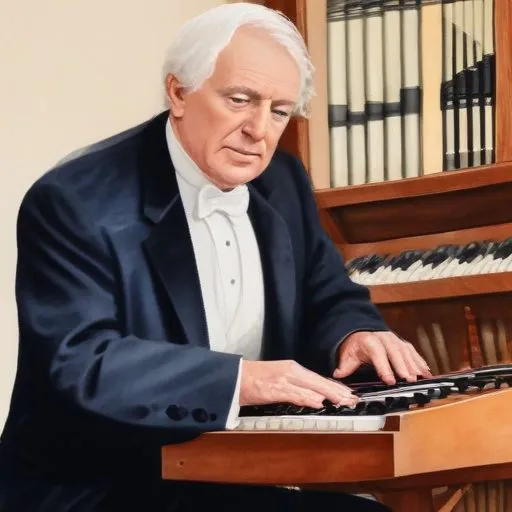
A renowned organist and composer, he was a prominent figure in British music, particularly in the Anglican church, and is best known for his hymn tunes and choral works.
Sir Henry Walford Davies was a renowned English composer, organist, and educator, best known for holding the esteemed title of Master of the King's Music from 1934 until 1941. During his illustrious career, he made significant contributions to the world of music, composing iconic pieces like the Royal Air Force March Past and providing music guidance to the British Broadcasting Corporation.
Born on September 6, 1869, in Oswestry, Shropshire, Davies was the seventh of nine children to John Whitridge Davies and Susan Gregory. His family was steeped in music, with his father being an amateur musician and founder of a choral society. Davies' early exposure to music led him to become a chorister at St. George's Chapel, Windsor Castle, in 1882.
After his voice broke in 1885, Davies became the organist of the Royal Chapel of All Saints, Windsor Great Park, and later served as secretary to Sir George Elvey's successor, Walter Parratt. During this period, he pursued his passion for music by taking the Cambridge Bachelor of Music examinations in 1889, although he initially failed. With the encouragement of Charles Villiers Stanford, Davies made a second attempt and graduated in 1891.
Davies' career was marked by several significant milestones. He composed the iconic Royal Air Force March Past during his service with the Royal Air Force during World War I. As music adviser to the British Broadcasting Corporation, he delivered commended talks on music between 1924 and 1941.
Some of his notable works include:
Davies' contributions to music were recognized with several honors, including:
Davies believed that music was an essential part of education and should be accessible to all. He advocated for the promotion of music in schools and was a strong supporter of amateur music-making.
Davies' legacy extends beyond the world of music. He played a crucial role in promoting music appreciation and education in the UK, inspiring future generations of musicians and music enthusiasts.
Throughout his life, Davies remained committed to his craft, leaving behind a rich legacy that continues to inspire and influence the world of music today.
Here is a brief timeline of Davies' life and career:
Born in 1872
A renowned composer and educator, he's celebrated for his symphonies and folk-song inspired works that evoke a sense of English heritage and nostalgia. His music is a testament to his love for his homeland's cultural roots.
Born in 1874
A renowned composer and educator, best known for his orchestral suite "The Planets", which evokes a sense of cosmic wonder and exploration. His music is a staple of classical repertoire, still widely performed today.
Born in 1892
A renowned British organist, composer, and educator, he was a prominent figure in the development of 20th-century Anglican church music, particularly in his contributions to the genre of hymnody.
Born in 1914
A prolific actor and director, known for his rugged, versatile performances in film and television, often playing cowboys and authority figures.
