


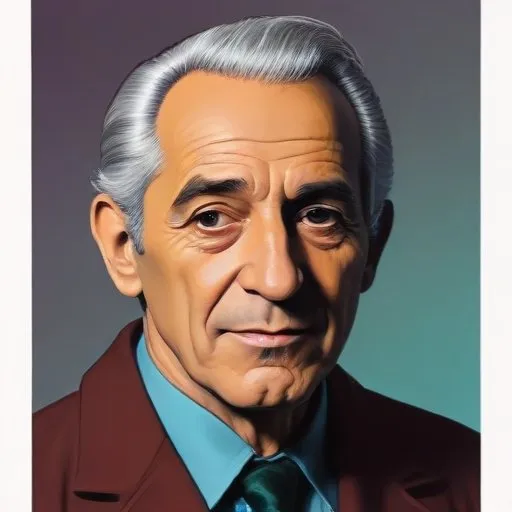
A pioneer of the 1950s and 60s California assemblage movement, creating collages and sculptures that blended surrealism and pop art, influencing the development of West Coast avant-garde art.
Wallace Berman, an American experimental filmmaker, assemblage, and collage artist, left an indelible mark on the history of postwar California art. Known for his innovative Verifax collages, Berman's work embodied the interdisciplinary spirit of the Beat movement, blending poetry, photographs, texts, drawings, and images into a unique artistic expression.
Berman was born on February 18, 1926, in Staten Island, New York, but his family relocated to Boyle Heights, Los Angeles, in the 1930s. Discharged from high school for gambling in the early 1940s, Berman became immersed in the West Coast jazz scene, even co-writing a song with Jimmy Witherspoon. He attended classes at Jepson Art Institute and Chouinard Art Institute in the 1940s, laying the groundwork for his artistic career.
For a few years, starting in 1949, Berman worked in a factory, finishing furniture, where he began creating sculptures from wood scraps. This marked the beginning of his full-time artistic pursuits, which eventually led him to become a key figure in the Beat movement. In the early 1950s, Berman married Shirley Morand, with whom he had a son, Tosh, in 1954.
In 1957, Berman moved to San Francisco, where he focused on creating his iconic magazine, Semina. This publication, which ran from 1955 to 1964, featured a diverse range of artistic expressions, including poetry, photographs, texts, drawings, and images, all carefully curated by Berman. Semina became a beacon for the Beat generation, attracting like-minded artists and intellectuals.
In the early 1960s, Berman began creating his groundbreaking Verifax collages. These innovative works combined photocopies of images from magazines and newspapers, mounted onto a flat surface, with occasional solid areas of acrylic paint. This unique technique allowed Berman to experiment with new forms of artistic expression, pushing the boundaries of collage and assemblage.
Dennis Hopper, a collector of Berman's work, cast him in a small role in his 1969 film, Easy Rider. Tragically, Berman's life was cut short in a car accident caused by a drunk driver on his 50th birthday, February 18, 1976. His death was eerily prophesied by a childhood statement to his mother, where he predicted his own demise on this exact date.
Berman's pioneering work has left an indelible mark on the art world. His innovative approach to collage and assemblage has inspired generations of artists, and his involvement in the Beat movement has cemented his place as a crucial figure in American cultural history. Today, Berman's work continues to fascinate and inspire, serving as a testament to the power of artistic innovation and creative experimentation.
Born in 1887
A pioneering artist who challenged conventional norms by submitting a urinal as art, sparking a revolution in conceptual art and questioning the very definition of art itself.
Born in 1890
A pioneer of avant-garde photography, this artist experimented with techniques like solarization and rayography, creating surreal, dreamlike images that blurred the line between art and photography.
90 Years Old
Iconic actor and director known for his rebellious, counterculture persona and memorable roles in films like "Easy Rider" and "Apocalypse Now".
92 Years Old
A pioneering multimedia artist, known for blending painting, photography, and film to create innovative, avant-garde works that explored the intersection of art and technology.
Born in 1925
A pioneer of pop art, combining found objects and images to create innovative, thought-provoking works that blurred the lines between art and everyday life.
96 Years Old
A pioneer of pop art, creating enigmatic works that explore the relationship between perception, reality, and meaning, often using common images like flags and targets.
