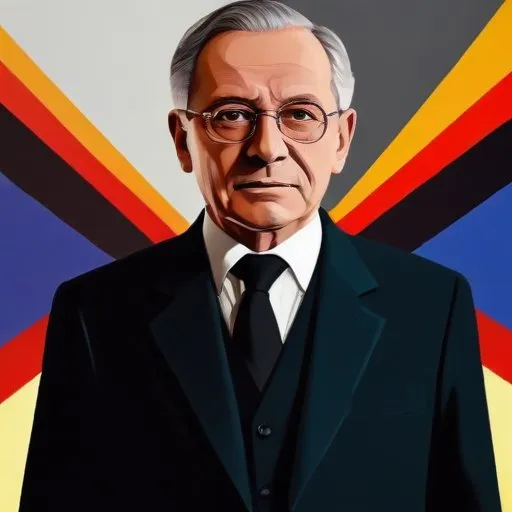
Walter Gerlach

Walter Gerlach

Walter Gerlach was born on August 1st, 1889

Full Name: Walter Gerlach
Nationality: German
Profession: Physicist, Academic
Research Focus: Quantum Mechanics
Education: University of Tübingen
Notable Students: Otto Hahn
Awards: Max Planck Medal
Publications: Annalen der Physik

A German physicist who conducted groundbreaking experiments on quantum mechanics, particularly the famous Stern-Gerlach experiment, which demonstrated the concept of spin in atoms.

Written by: Oliver Wren Oliver Wren

Walter Gerlach: The Maverick Physicist Behind the Stern-Gerlach Experiment

Walter Gerlach, a German physicist, is renowned for his groundbreaking work on the Stern-Gerlach experiment, a pioneering study that laid the foundation for modern quantum mechanics. In 1922, Gerlach, along with Otto Stern, successfully demonstrated the concept of spin quantization, revolutionizing our understanding of atomic structure and behavior.

A Life of Science and Curiosity

Born on August 1, 1889, in Biebrich, Germany, Gerlach's fascination with the natural world was evident from an early age. He pursued his passion for physics at the University of Tübingen, where he earned his Ph.D. in 1916. Gerlach's research focused on experimental physics, particularly in the realm of atomic and molecular physics.

The Stern-Gerlach Experiment: A Quantum Leap

In 1921, Gerlach teamed up with Otto Stern to investigate the properties of atomic beams. Their experiment, which would later bear their names, involved passing a beam of silver atoms through a non-uniform magnetic field. The results were astonishing: the beam split into two distinct beams, demonstrating the quantization of angular momentum.

This breakthrough discovery confirmed the hypothesis of Niels Bohr's atomic model, which stated that electrons occupy specific energy levels within an atom. The Stern-Gerlach experiment not only validated Bohr's theory but also paved the way for the development of quantum mechanics.

War, Research, and Redemption

During World War II, Gerlach's research shifted towards the development of atomic energy. Although he was not a member of the Nazi party, his involvement in the German war effort has been a subject of controversy. In the post-war era, Gerlach dedicated himself to rebuilding German physics and promoting international scientific cooperation.

Awards and Honors

Gerlach's contributions to physics were recognized with numerous awards, including the Max Planck Medal (1949) and the Hughes Medal (1957). He was also elected a foreign member of the Royal Society (1957) and the American Academy of Arts and Sciences (1962).

Personal Milestones and Legacy

Gerlach's personal life was marked by tragedy, including the loss of his son in World War II. He passed away on August 10, 1979, in München, Germany, leaving behind a legacy that continues to inspire generations of physicists. Today, the Stern-Gerlach experiment remains a cornerstone of quantum mechanics, and Gerlach's work serves as a testament to human curiosity and the power of scientific collaboration.

Trivia and Fun Facts

Timeline
1889
Born in Biebrich
Walter Gerlach was born in Biebrich, German Empire (now Biebrich, Wiesbaden, Hesse, Germany).
1912
Earned Ph.D. in Physics
Gerlach earned his Ph.D. in physics from the University of Tübingen.
1920
Discovered the Stern-Gerlach Effect
Gerlach and Otto Stern discovered the Stern-Gerlach effect, which showed that atoms have an intrinsic angular momentum known as spin.
1944
Became Director of the Max Planck Institute
Gerlach became the director of the Max Planck Institute for Physics in Munich.
1979
Died in Munich
Walter Gerlach died in Munich, West Germany at the age of 90.
Walter Gerlach

Walter Gerlach Quiz

What is the primary concept demonstrated by the Stern-Gerlach experiment?

Score: 0/5
FAQ
What was Walter Gerlachs contribution to the discovery of nuclear spin?
Walter Gerlach was a German physicist who, along with Otto Stern, discovered the phenomenon of nuclear spin in 1922. Their experiment, known as the Stern-Gerlach experiment, demonstrated the existence of spin in atomic nuclei.
What was Walter Gerlachs academic career like?
Walter Gerlach was a professor of physics at the University of Tübingen and later at the University of Munich. He was a respected teacher and mentor, and his students went on to become prominent physicists in their own right.
What was Walter Gerlachs early life like?
Walter Gerlach was born on August 1, 1889, in Frankfurt am Main, German Empire. He came from a family of intellectuals and was encouraged to pursue his love of physics from an early age.
How did Walter Gerlach contribute to the development of quantum mechanics?
Walter Gerlachs work on nuclear spin and the Stern-Gerlach experiment contributed significantly to the development of quantum mechanics. His research laid the groundwork for later discoveries in the field.
What was Walter Gerlachs legacy?
Walter Gerlachs legacy is one of innovation and excellence in physics. He is remembered as one of the most important physicists of the 20th century, and his discovery of nuclear spin paved the way for future breakthroughs in quantum mechanics.

Related People:

Werner Heisenberg

Born in 1901

A pioneer in quantum mechanics, he formulated the uncertainty principle, which revolutionized our understanding of the atomic world. His groundbreaking work reshaped modern physics.

Niels Bohr

Born in 1885

A pioneer in quantum mechanics, he introduced the concept of wave-particle duality, revolutionizing our understanding of atomic structure. His philosophical approach to science also explored the nature of reality and human understanding.

Albert Einstein

Born in 1879

A brilliant physicist who developed the theory of relativity and is considered one of the most influential scientists of the 20th century, known for his groundbreaking work in physics and mathematics.

Max Planck

Born in 1858

A pioneer in quantum theory, he introduced the concept of the Planck constant, revolutionizing our understanding of energy and matter.

Otto Hahn

Born in 1879

A pioneering nuclear chemist who discovered nuclear fission, a process that releases massive energy from atomic nuclei, and was awarded the Nobel Prize in Chemistry in 1944.

Lise Meitner

Born in 1878

Pioneering physicist who made groundbreaking contributions to nuclear physics, including the discovery of nuclear fission, and was the first woman to become a full professor of physics in Germany.

Hans Bethe

Born in 1906

A renowned physicist and Nobel laureate who made groundbreaking contributions to our understanding of the universe, particularly in the fields of nuclear physics and astrophysics.