


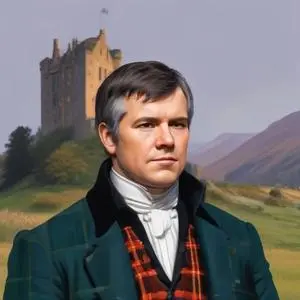
A renowned author of historical novels, plays, and poetry, credited with creating the genre of historical fiction and influencing the development of the novel as a literary form.
Sir Walter Scott, a Scottish novelist, poet, and historian, is renowned for his contribution to European and Scottish literature. His works, such as Ivanhoe, Rob Roy, Waverley, and The Lady of the Lake, have become classics of their time, shaping the historical novel genre and leaving an indelible mark on literary history.
Walter Scott was born on August 15, 1771, in Edinburgh, Scotland, to Walter Scott, a Writer to the Signet, and Anne Rutherford. He was the ninth child of the family, with six siblings having died in infancy. Scott's family heritage was rich in history, with his mother's side tracing back to the Clan Swinton and the Haliburton family.
Scott pursued a career in law, following in his father's footsteps, and became an advocate, judge, and legal administrator. However, his true passion lay in writing and literature. He combined his daily work as Clerk of Session and Sheriff-Depute of Selkirkshire with writing and editing, producing some of his most notable works.
Scott was recognized for his contributions to literature and society, becoming a baronet of Abbotsford in 1820. He was also an active member of several societies, including the Highland Society, the Royal Society of Edinburgh, and the Society of Antiquaries of Scotland.
Scott's works have had a lasting impact on European and American literature, influencing authors such as Charles Dickens, the Brontë sisters, and Alexandre Dumas. His historical novels have shaped the way people perceive and understand history, making it more accessible and engaging for a wider audience.
Scott's legacy extends beyond his literary contributions, as he played a significant role in promoting Scottish culture and heritage. His works have contributed to the preservation of Scottish history, folklore, and traditions, ensuring their continued relevance in modern times.
Sir Walter Scott's life and works continue to captivate readers and inspire writers to this day, leaving behind a legacy that is both timeless and boundless.
Born in 1775
A celebrated author of witty, romantic novels of manners that offer insightful commentary on 19th-century English society, particularly the lives of women. Her works remain beloved for their strong female characters, clever dialogue, and nuanced exploration of relationships.
Born in 1812
A renowned author of timeless classics, crafting vivid stories that exposed social injustices and explored the human condition, leaving an indelible mark on literature.
Born in 1850
A Scottish novelist, poet, and essayist who wrote iconic adventure novels, including "Treasure Island" and "Dr. Jekyll and Mr. Hyde", that have captivated readers for generations.
Born in 1892
Creator of Middle-earth, a richly detailed fantasy world, and author of The Hobbit and The Lord of the Rings trilogy, which have become cultural touchstones.
Born in 1759
Celebrated for his poignant and lyrical poetry, he penned iconic works that capture the essence of Scottish culture and identity. His contributions to literature continue to inspire and delight readers worldwide.
Born in 1866
A visionary writer who pioneered the science fiction genre, crafting timeless classics like "The Time Machine" and "War of the Worlds" that continue to inspire and captivate audiences today.
Born in 1809
A master of dark and atmospheric storytelling, crafting haunting tales of mystery and horror that continue to captivate readers to this day.
Born in 1797
Author of Gothic novels, particularly the iconic "Frankenstein", which has become a cultural phenomenon and influenced countless adaptations and reinterpretations.
