


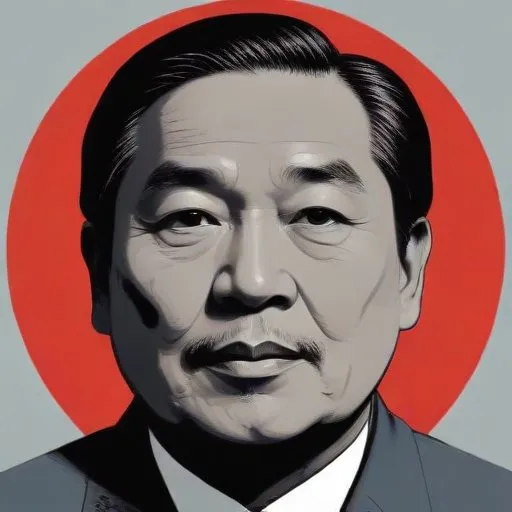
A Chinese politician who led a Japanese-backed puppet government in China during World War II, known for his controversial role in collaborating with the enemy.
Wang Jingwei, pen name Wang Zhaoming, was a prominent Chinese politician who served as the president of the Reorganized National Government of the Republic of China, a Japanese-backed puppet state during World War II. He is known for his tumultuous career, which spanned from being a close associate of Sun Yat-sen to collaborating with the Japanese Empire, earning him a reputation as a traitor in the eyes of many.
Wang Jingwei was born on May 4, 1883, in Sanshui, Guangdong, but was of Zhejiang origin. He was sponsored by the Qing Dynasty government to study in Japan in 1903, where he joined the Tongmenghui in 1905 and adopted the sobriquet Wang Jingwei.
During his time in Japan, Wang became disillusioned with the Qing dynasty, which he believed was holding China back and making it vulnerable to Western imperialist powers. He was drawn to theories of democracy and liberalism, and cut off his queue, a symbol of the traditional Chinese hairstyle, to show his commitment to modernizing China.
Wang returned to China in 1906 and became involved in the Xinhai Revolution, playing a key role in the overthrow of the Qing dynasty. He was a close associate of Sun Yat-sen, the father of modern China, and served as the Vice Premier of the Kuomintang (KMT) government in 1924.
After Sun's death in 1925, Wang engaged in a power struggle with Chiang Kai-shek, eventually losing control of the KMT. Despite this, Wang remained in the party and continued to have disagreements with Chiang, which ultimately led to his collaboration with the Japanese Empire.
In 1938, Wang accepted an invitation from the Japanese Empire to form a collaborationist government in Nanjing, which he led until his death in 1944. This decision has been widely criticized, and Wang's legacy remains controversial among historians.
Wang's collaboration with Japan has been seen as a betrayal of the Chinese people, and his name has become synonymous with treason. However, some historians argue that Wang's decision was motivated by a desire to protect Chinese lives and minimize the destruction caused by the Japanese occupation.
Wang Jingwei's legacy is complex and multifaceted. While he played a significant role in the Xinhai Revolution and was a key figure in modern Chinese history, his collaboration with Japan has overshadowed his earlier achievements.
In recent years, there has been a reevaluation of Wang's legacy, with some historians arguing that he was a pragmatic leader who made difficult decisions in a time of crisis. However, for many, Wang remains a symbol of treachery and betrayal.
Wang's collaboration with Japan has been widely criticized, both during his lifetime and after his death. Many have accused him of being a traitor, and his name has become a byword for treachery in China.
Some historians have also criticized Wang's leadership style, arguing that he was authoritarian and prone to making decisions without consulting others.
Ultimately, Wang Jingwei's legacy is a complicated one, marked by both significant achievements and grave mistakes. While he played a significant role in shaping modern Chinese history, his collaboration with Japan has overshadowed his earlier accomplishments, and his name remains a controversial one in Chinese history.
Born in 1887
Led the Nationalist Party in China, fighting against the Communist Party and later establishing the government of Taiwan. He's known for his role in shaping modern Chinese history.
Born in 1893
Leader of the Chinese Communist Party who implemented radical social and economic reforms, including the Great Leap Forward and the Cultural Revolution, shaping modern China's politics and economy.
Born in 1898
The first Premier of the People's Republic of China, serving from 1949 until his death in 1976, is most known for his key role in the Chinese Communist Party and his diplomatic efforts to improve relations with the West. He played a crucial part in shaping China's foreign policy and economy during a pivotal period in the country's history.
Born in 1866
A Chinese revolutionary who led the overthrow of the Qing dynasty and founded the Republic of China, known for his role in shaping modern China's government and politics.
