


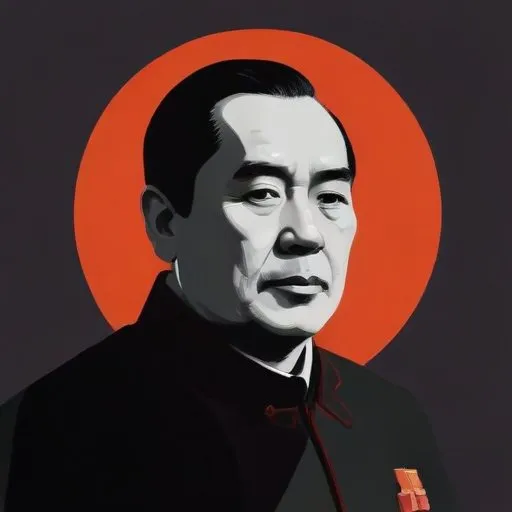
A Chinese diplomat who played a key role in the country's early 20th-century international relations, advocating for China's sovereignty and participating in the Paris Peace Conference. He was a pioneer in modern Chinese diplomacy.
Wellington Koo, a Chinese diplomat and statesman, is renowned for his instrumental role in shaping China's foreign policy and international relations in the 20th century. As one of China's representatives at the Paris Peace Conference of 1919, Koo played a pivotal role in the founding of the League of Nations and the United Nations, cementing his legacy as a champion of global cooperation and diplomacy.
Born in 1888 in Jiading, a suburb of Shanghai, Koo grew up in an upper-class cosmopolitan family that valued modern education and cultural exchange. Fluently speaking English and French, Koo's linguistic abilities greatly aided his future diplomatic career. The Treaty of Shimonoseki, which ended the First Sino-Japanese War in 1895, had a profound impact on Koo, fueling his desire to work towards China's recovery and the removal of the Japanese menace.
Koo's diplomatic career spanned several decades, with notable appointments as ambassador to France, Great Britain, and the United States. He played a crucial role in the founding of the League of Nations and the United Nations, participating in the Paris Peace Conference and the San Francisco Conference respectively. From 1957 to 1967, Koo served as a judge on the International Court of Justice in The Hague, further solidifying his reputation as a respected international statesman.
Koo briefly held the concurrent positions of acting premier and interim president of the Republic of China between October 1926 and June 1927, making him the first Chinese head of state to use a Western name publicly. This milestone not only reflected Koo's modernizing influence on Chinese politics but also underscored his commitment to international engagement.
Koo's diplomatic efforts had a profound impact on modern China, shaping the country's foreign policy and international relations. His advocacy for global cooperation and diplomacy helped to establish China as a major player on the world stage, paving the way for future diplomatic successes. Koo's legacy continues to inspire Chinese diplomats and policymakers, ensuring his influence extends far beyond his own lifetime.
Koo's diplomatic achievements were underpinned by his philosophical beliefs in the importance of international cooperation, modernization, and cultural exchange. His desire to remove the 'Japanese menace' and promote China's recovery reflects his commitment to national pride and sovereignty. Through his actions and writings, Koo advocated for a more inclusive and harmonious world order.
Wellington Koo's remarkable life and career serve as a testament to the power of diplomacy, international cooperation, and cultural exchange. As a visionary statesman, Koo played a pivotal role in shaping modern China's foreign policy and international relations, leaving behind a rich legacy that continues to inspire generations of diplomats, policymakers, and scholars alike.
Born in 1866
A Chinese revolutionary who led the overthrow of the Qing dynasty and founded the Republic of China, known for his role in shaping modern China's government and politics.
Born in 1887
Led the Nationalist Party in China, fighting against the Communist Party and later establishing the government of Taiwan. He's known for his role in shaping modern Chinese history.
Born in 1893
Leader of the Chinese Communist Party who implemented radical social and economic reforms, including the Great Leap Forward and the Cultural Revolution, shaping modern China's politics and economy.
Born in 1898
The first Premier of the People's Republic of China, serving from 1949 until his death in 1976, is most known for his key role in the Chinese Communist Party and his diplomatic efforts to improve relations with the West. He played a crucial part in shaping China's foreign policy and economy during a pivotal period in the country's history.
Born in 1904
A Chinese revolutionary and statesman who led the country's economic reforms, transforming it into a global superpower. He's credited with opening up China to the world and introducing capitalist principles.
Born in 1915
A Chinese reformer who served as General Secretary of the Communist Party, known for his efforts to liberalize the economy and increase individual freedoms. His death sparked the Tiananmen Square protests.
Born in 1919
A Chinese reformer who served as Premier from 1980 to 1989, known for introducing market-oriented economic reforms and supporting democratic movements, ultimately leading to his purge.
Born in 1926
Former Chinese leader who ruled the country from 1989 to 2004, known for his economic reforms and authoritarian grip on power. He's also famous for his "Three Represents" theory, which aimed to broaden the Communist Party's appeal.
