


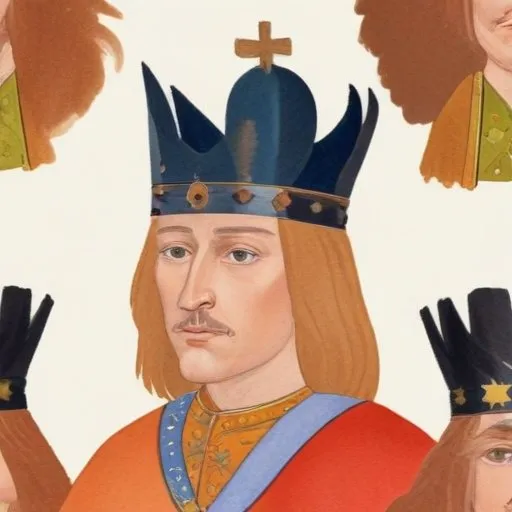
Ruler of Bohemia and Poland, known for his diplomatic and military skills, which led to a period of relative peace and prosperity in his kingdoms.
Wenceslaus II of Bohemia is renowned for his remarkable achievements in unifying Poland and Bohemia, becoming the King of Bohemia from 1278 to 1305, Duke of Cracow from 1291 to 1305, and King of Poland from 1296 to 1305. His strategic marriages and alliances enabled him to expand his territories, solidifying his position as a powerful monarch in Central Europe.
Wenceslaus II was born on September 27, 1271, to King Ottokar II of Bohemia and his second wife, Kunigunda. His birth was a result of a ten-year marriage, and his mother's lineage connected him to the royal families of Kiev and Hungary. Tragically, his father died in the Battle on the Marchfeld in 1278, when Wenceslaus was just seven years old.
Before Wenceslaus came of age, Otto V, Margrave of Brandenburg, handled the government, allegedly holding Wenceslaus captive in various locations. Wenceslaus returned to Bohemia in 1283, at the age of twelve, and married Judith of Habsburg, daughter of Rudolf I, in 1285. This union was a strategic move, as it created an uneasy peace between Bohemia and the Holy Roman Empire.
In 1290, Wenceslaus had his stepfather, Zvi of Falkenstein, beheaded for alleged treason and began ruling independently. He then focused on expanding his territories, acquiring the sovereign Duchy of Krakow from High Duke Przemys II of Poland in 1291. After Przemys' death in 1296, Wenceslaus annexed the remaining Polish duchies, solidifying his position as the King of Poland.
Wenceslaus II played a crucial role in shaping the history of Central Europe, unifying Poland and Bohemia under his rule. His legacy extends beyond his territorial conquests, as he also established a strong economy and fostered a cultural renaissance in his kingdoms. He is remembered as a skilled diplomat, strategist, and leader who left a lasting impact on the region.
Wenceslaus II's reign marked the beginning of the Pemyslid dynasty's golden age, cementing his position as one of the most significant figures in Bohemian and Polish history. His influence can still be seen in the modern-day borders and politics of Central Europe, a testament to his enduring legacy.
Born in 1500
Ruling over a vast empire from 1519 to 1556, he was a powerful and influential leader who played a crucial role in shaping European politics and religion. He is most known for his efforts to unify Christian Europe and defend it against the Ottoman Empire.
Born in 1503
The first Habsburg to rule the Holy Roman Empire, he unified Austria and introduced the concept of a hereditary monarchy, shaping European politics for centuries to come.
Born in 1747
The last Habsburg ruler to hold the title of Holy Roman Emperor, he oversaw the dissolution of the empire and played a key role in European politics during the French Revolution.
Born in 1500
Ruling over a vast empire from 1519 to 1556, he was a powerful and influential leader who played a crucial role in shaping European politics and religion. He is most known for his efforts to unify Christian Europe and defend it against the Ottoman Empire.
Born in 1086
Ruling the Holy Roman Empire from 1111 to 1125, he was a powerful monarch who clashed with the Catholic Church over investiture, sparking a major controversy. He's also known for his complex, often tumultuous relationships with nobles and bishops.
