


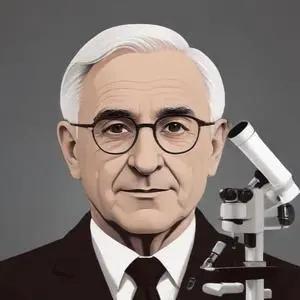
A pioneer in molecular biology, discovering restriction enzymes that allow scientists to edit DNA, revolutionizing genetic engineering and earning a Nobel Prize.
Werner Arber, a Swiss microbiologist and geneticist, is best known for his groundbreaking discovery of restriction endonucleases, which earned him the Nobel Prize in Physiology or Medicine in 1978, alongside American researchers Hamilton Smith and Daniel Nathans. This pioneering work led to the development of recombinant DNA technology, transforming the field of molecular genetics.
Born on June 3, 1929, in Gränichen, Aargau, Switzerland, Arber's fascination with science began at an early age. He pursued his passion at the Swiss Federal Institute of Technology in Zürich, where he studied chemistry and physics from 1949 to 1953.
Arber's research journey took a significant turn when he joined the University of Geneva as an assistant for electron microscopy in 1953. Later, he shifted his focus to bacteriophages and wrote his dissertation on defective lambda prophage mutants. His work on lambda-mediated transduction gene transfer, inspired by the experiments of Larry Morse and Esther and Joshua Lederberg, marked the beginning of his illustrious career as a molecular geneticist.
In 1978, Arber was awarded the Nobel Prize in Physiology or Medicine for his discovery of restriction endonucleases. This recognition marked a significant milestone in his career, acknowledging his contribution to the understanding of molecular genetics. Arber's work has had a profound impact on the field, paving the way for breakthroughs in genetic engineering and biotechnology.
Arber's work is a testament to the power of interdisciplinary research and collaboration. He has emphasized the importance of combining genetic and physiological approaches to understand the intricacies of molecular genetics. His contributions have not only advanced our understanding of genetic mechanisms but have also inspired future generations of scientists.
Arber's work has far-reaching implications for various fields, including medicine, biotechnology, and genetics. His discovery of restriction endonucleases has enabled the development of genetic engineering techniques, which have transformed the way we approach disease diagnosis and treatment. His contributions have paved the way for significant advances in gene therapy and genetic research.
Did you know that Arber's research was inspired by the experiments of Larry Morse and Esther and Joshua Lederberg? This chance encounter led him to shift his focus from electron microscopy to bacteriophages, ultimately changing the course of his career!
Werner Arber's remarkable journey is a testament to the power of curiosity, perseverance, and collaboration. His groundbreaking work has left an indelible mark on the field of molecular genetics, inspiring future generations of scientists to continue pushing the boundaries of human knowledge.
Born in 1916
Pioneering scientist who discovered the structure of DNA, revolutionizing our understanding of genetics and life itself.
98 Years Old
Discovered the structure of DNA, revolutionizing our understanding of genetics and earning a Nobel Prize. Pioneering work in molecular biology has far-reaching implications for medicine and beyond.
Born in 1920
A British scientist who contributed significantly to the discovery of the structure of DNA, providing high-quality X-ray crystallography images that helped James Watson and Francis Crick develop their famous model.
Born in 1916
A Nobel Prize-winning physicist and biologist who contributed significantly to the discovery of the structure of DNA, using X-ray crystallography to produce the first clear images of the molecule.
Born in 1905
A pioneer in DNA research, this biochemist discovered the base pairing rules of DNA, leading to a fundamental understanding of genetic code.
Born in 1881
Discovered penicillin, a revolutionary antibiotic, and pioneered its use in medicine. This breakthrough has saved countless lives and transformed the field of healthcare.
Born in 1749
Developed the smallpox vaccine, revolutionizing disease prevention and saving countless lives.
Born in 1914
Developed the first inactivated poliovirus vaccine, leading to the near eradication of polio, and founded the Salk Institute for Biological Studies.
