


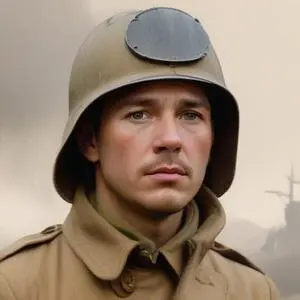
A soldier-poet who captured the horrors of World War I through vivid and powerful verse, conveying the brutal reality of war and its effects on humanity.
Wilfred Owen, a renowned English poet and soldier, is best known for his haunting and evocative poetry that exposed the brutal realities of World War I. Through his works, he conveyed the devastating effects of war on the human psyche, making him one of the most celebrated poets of the Great War.
Born on March 18, 1893, in Oswestry, Shropshire, Owen was the eldest of four children to Thomas and Harriett Susan Owen. His family's frequent relocations led him to attend schools in Birkenhead and Shrewsbury, where he developed a passion for poetry.
In 1915, Owen enlisted in the British Army and was commissioned as a lieutenant in the Manchester Regiment. His experiences in the trenches and the horrors of war deeply affected him, sparking a creative outburst of poetry. Under the mentorship of Siegfried Sassoon, Owen's poetry took a more nuanced and realistic tone, starkly contrasting with the patriotic verse of earlier war poets like Rupert Brooke.
Owen's most celebrated poems, published posthumously, include:
Owen was killed in action on November 4, 1918, just a week before the war's end, at the age of 25. His poetry, published posthumously, has had a profound impact on modern literature, influencing generations of writers and artists. Owen's legacy extends beyond his poetry, as his unflinching portrayal of war's horrors has shaped public perception and understanding of the devastating consequences of conflict.
Owen's poetry reflects his deep-rooted humanitarianism and anti-war sentiments. His works emphasize the importance of empathy and compassion, highlighting the need for humanity to recognize the devastating effects of war on individuals and society as a whole.
Owen's close friendship with Siegfried Sassoon, a fellow poet and soldier, had a significant impact on his writing style and development as a poet. Owen's relationship with his mother, Harriett, was also instrumental in shaping his early life and poetry.
Owen's poetry has inspired numerous adaptations, including film, theater, and music. His works continue to resonate with audiences, influencing modern literature, art, and popular culture. Owen's unflinching portrayal of war's horrors has also contributed to a shift in public perception, inspiring anti-war movements and promoting a more nuanced understanding of the human cost of conflict.
"My subject is War, and the pity of War. The Poetry is in the pity."
Wilfred Owen's legacy serves as a poignant reminder of the devastating consequences of war, making him one of the most celebrated and influential poets of the 20th century.
Born in 1886
A decorated World War I officer turned anti-war poet, known for his vivid and haunting accounts of trench life, influencing modern war literature.
Born in 1895
A renowned poet, novelist, and critic, best known for his historical novels, particularly "I, Claudius" and "Count Belisarius", which vividly brought ancient civilizations to life.
Born in 1887
A celebrated poet of the Georgian school, known for his romantic and patriotic verse, particularly his sonnets that captured the spirit of World War I.
Born in 1885
A pioneering modernist poet and critic who transformed 20th-century literature with innovative styles and provocative ideas, shaping the course of modern poetry.
Born in 1888
A renowned poet, playwright, and critic who reshaped modern poetry with works like "The Waste Land" and "Old Possum's Book of Practical Cats", influencing literature and art with their unique style.
Born in 1882
A pioneering author of modernist literature, known for experimental novels and essays that explored the human experience, blurring the lines between reality and fiction.
Born in 1885
A pioneering writer of the early 20th century, known for exploring themes of human nature, relationships, and the clash between individual desire and societal expectations through novels like "Sons and Lovers" and "Lady Chatterley's Lover".
Born in 1873
A pioneering modernist writer, credited with influencing 20th-century literature through experimental novels and poetry that explored the human condition. Known for his impressionistic style and complex characters.
