


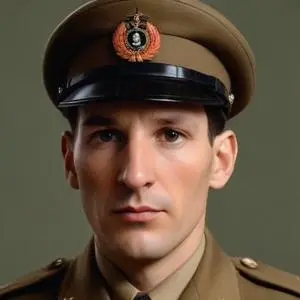
A decorated World War I officer turned anti-war poet, known for his vivid and haunting accounts of trench life, influencing modern war literature.
Siegfried Sassoon is best known for his powerful and evocative war poetry, which captured the horrors and futility of the First World War, and for his bold protest against the continuation of the war. As a decorated soldier and prominent poet, Sassoon's work not only described the brutal realities of the trenches but also satirized the patriotic pretensions of those who, in his view, were responsible for a jingoism-fueled war.
Sassoon was born on September 8, 1886, to a Jewish father, Alfred Ezra Sassoon, and an Anglo-Catholic mother, Theresa, in Matfield, Kent. His father was a member of the wealthy Baghdadi Jewish Sassoon merchant family, but he was disinherited for marrying outside the Jewish faith. Sassoon's mother, Theresa, belonged to the Thornycroft family, sculptors responsible for many of London's iconic statues. He was the second of three sons, and his parents separated when he was just four years old. After his father's death in 1895, Sassoon was educated at the New Beacon School and later at Marlborough College.
Sassoon's experiences in the trenches during World War I had a profound impact on his writing and worldview. He was decorated for bravery on the Western Front, but his exposure to the harsh realities of war led him to question the morality and purpose of the conflict. In July 1917, Sassoon made a lone protest against the continuation of the war with his "Soldier's Declaration," which was read out in the British House of Commons. This act of defiance earned him a stint at the Craiglockhart War Hospital, where he met and befriended fellow poet Wilfred Owen.
Sassoon's poetry, including his famous collections The Old Huntsman and Counter-Attack, is characterized by its vivid imagery, biting satire, and unflinching portrayal of the horrors of war. He went on to win acclaim for his prose work, particularly his three-volume, fictionalized autobiography, collectively known as the Sherston trilogy. This trilogy, comprising Memoirs of a Fox-Hunting Man, Memoirs of an Infantry Officer, and Sherston's Progress, is considered one of the greatest works of 20th-century English literature.
Sassoon's personal life was marked by turmoil and controversy. He struggled with his sexuality, and his relationships with men, including his close friendship with Wilfred Owen, were the subject of much speculation and gossip. Sassoon's later years were also marked by controversy, particularly his conversion to Catholicism in 1957, which was seen as a betrayal by some of his former friends and acquaintances.
Sassoon's words continue to inspire and provoke, offering a searing indictment of war and the human cost of conflict:
Siegfried Sassoon's life and work serve as a powerful reminder of the devastating consequences of war and the importance of speaking truth to power. His courageous protest and unflinching portrayal of the horrors of war have inspired generations of writers, artists, and activists, cementing his place as one of the most important and influential figures of the 20th century.
Siegfried Sassoon passed away on September 1, 1967, leaving behind a legacy of courage, conviction, and literary genius that continues to inspire and challenge us today.
Born in 1895
A renowned poet, novelist, and critic, best known for his historical novels, particularly "I, Claudius" and "Count Belisarius", which vividly brought ancient civilizations to life.
Born in 1893
A soldier-poet who captured the horrors of World War I through vivid and powerful verse, conveying the brutal reality of war and its effects on humanity.
Born in 1887
A celebrated poet of the Georgian school, known for his romantic and patriotic verse, particularly his sonnets that captured the spirit of World War I.
Born in 1893
A renowned poet, art critic, and anarchist, he championed modern art and literature, influencing the development of Surrealism and Existentialism. His writings explored the intersection of art, politics, and psychology.
Born in 1873
A pioneering modernist writer, credited with influencing 20th-century literature through experimental novels and poetry that explored the human condition. Known for his impressionistic style and complex characters.
Born in 1896
A British literary figure who wrote poetry and criticism, and is best known for his vivid and poignant portrayals of World War I. His works are considered some of the most evocative and powerful accounts of the war.
