


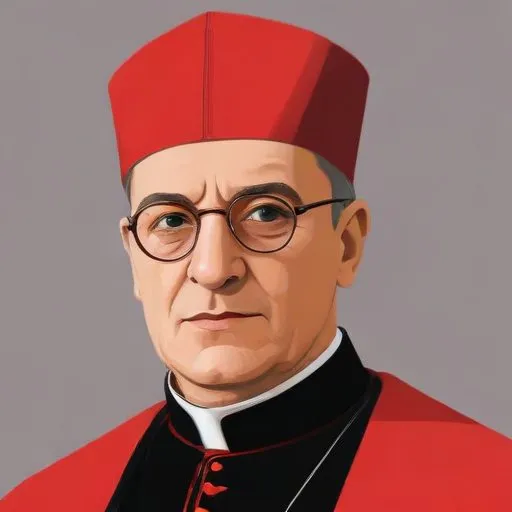
A 17th-century Catholic cardinal who played a significant role in the Thirty Years' War and was a prominent figure in the Holy Roman Empire's politics. He was also a skilled diplomat and strategist.
Wilhelm Egon von Frstenberg, a German count and prince of Frstenberg-Heiligenberg, was a mastermind of European politics in the 17th century. His rise to prominence as a bishop, statesman, and diplomat is marked by his cunning and strategic alliances that shaped the course of European history.
Born on December 2, 1629, Wilhelm was the younger son of Egon VIII of Frstenberg-Heiligenberg and Anna Maria of Hohenzollern-Hechingen. His father's untimely death in 1635 led Wilhelm to pursue a career in the clergy, a path that would eventually propel him to the forefront of European politics.
Wilhelm's education took him to the Gymnasium Tricoronatum, where he formed lasting friendships with Maximilian Heinrich of Bavaria and his elder brother, Franz Egon. These relationships would prove pivotal in shaping his future career. He later studied in Louvain and Rome, where he impressed Pope Innocent X, a connection that would serve him well in his rise to power.
In 1648, Wilhelm became subdeacon in the cathedral chapter at Cologne, marking the beginning of his ascent in the Church and politics. His brother Franz's influence in the Archbishop-Elector's privy council soon propelled Wilhelm into the inner circle of power.
Their friendship with Maximilian Heinrich of Bavaria, who became the Archbishop-Elector in 1650, cemented Wilhelm's position as a key advisor and strategist. This trio of influential friends would go on to shape the course of European politics in the decades to come.
Cardinal Mazarin, a powerful French statesman, took notice of Wilhelm's rising influence and cultivated him as a supporter of French interests within the Holy Roman Empire. In 1651, during the Fronde, Mazarin stayed in Cologne, where he forged a lasting bond with Wilhelm and Franz.
Mazarin's patronage granted Wilhelm control of the Abbey of St. Michel en Thirache near Soissons in 1656, further solidifying his position as a powerful figure in European politics.
Wilhelm's Machiavellian machinations eventually led to his downfall. He was arrested and tried for treason in 1661, accused of convincing the Elector to fight against the Empire. Although he was eventually released, Wilhelm's reputation as a cunning strategist and power broker was cemented.
Through his complex web of alliances and strategic maneuvers, Wilhelm Egon von Frstenberg left an indelible mark on European politics in the 17th century. His legacy serves as a testament to the enduring power of clever diplomacy and strategic thinking.
Wilhelm Egon von Frstenberg's remarkable career serves as a testament to the intricate web of alliances, diplomacy, and power struggles that defined 17th-century European politics.
Born in 1417
A 15th-century pope who played a significant role in the fall of the Western Schism, ending the division in the Catholic Church. He's also known for his lavish spending and nepotism.
Born in 1881
Reformed the Catholic Church, introducing progressive reforms and ecumenical dialogue, and convened the Second Vatican Council.
Born in 1879
A German nobleman who served as Chancellor of Germany in 1932, known for his role in appointing Adolf Hitler as Chancellor, paving the way for the Nazi regime.
