


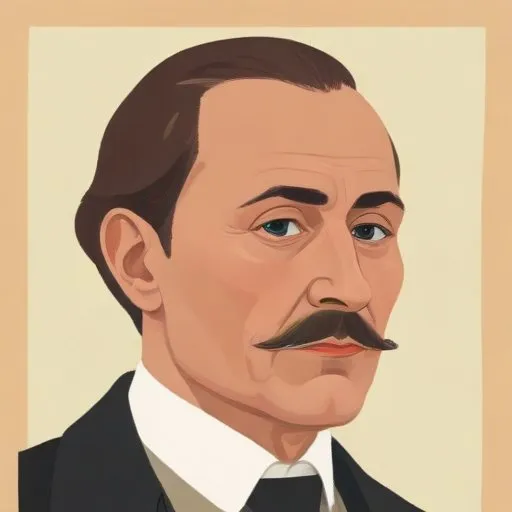
A Russian poet and author who wrote influential works that explored themes of patriotism, freedom, and social justice, leaving a lasting impact on Russian literature.
Wilhelm Kchelbecker, a Russian Romantic poet of German descent, is celebrated for his poignant works that resonated with the souls of his contemporaries, including the great Alexander Pushkin. He is also remembered as a zealous Decembrist revolutionary who dared to challenge the Russian monarchy.
Born on June 10, 1797, in St. Petersburg, Russia, Kchelbecker belonged to a Baltic German noble family. His childhood was spent in present-day Estonia, where he developed a deep appreciation for literature and poetry. He later attended the prestigious Tsarskoye Selo Lyceum near Saint Petersburg, where he befriended Pushkin and Anton Delvig, two stalwarts of Russian literature.
In 1821, Kchelbecker traveled to Paris to deliver courses on Russian literature. However, his liberal views were deemed too radical by the Russian administration, and he was forced to return to Russia. This experience did not deter him from pursuing his passion for literature. Alongside Vladimir Odoevsky, he launched the literary miscellany Mnemozina in 1824, which became a platform for Russian Romantics.
Kchelbecker's poetry reflects his pantheistic vision of the world, infused with a sense of Russian patriotism. Although he considered himself a literary conservative and classicist, his works bore the hallmarks of Romanticism. His most celebrated poem is the elegy on Pushkin's death, a poignant tribute that closed the Golden Age of Russian Poetry.
Beyond poetry, Kchelbecker experimented with satire and prose. His short piece, European Letters (1820), envisions a dystopian Europe in the 26th century. In the satirical fragment Land of the Headless (1824), the protagonist travels to the Moon and discovers a nightmarish society.
Kchelbecker's personal life was marked by friendships with notable figures like Pushkin, who dedicated a heartfelt stanza to him in the Lyceum Anniversary of 1825. Despite his perceived eccentricities, Kchelbecker was cherished by his friends, who appreciated his quixotic nature and literary genius.
Kchelbecker's contributions to Russian literature are undeniable. As a pioneering Decembrist revolutionary, he played a significant role in shaping the country's literary and political landscape. His poetry, though not widely recognized during his lifetime, continues to inspire generations of Russian writers and intellectuals.
In conclusion, Wilhelm Kchelbecker's life was a testament to the power of creative expression and revolutionary idealism. His remarkable legacy serves as a beacon, illuminating the intricate relationships between art, literature, and politics in 19th-century Russia.
Born in 1799
Russia's literary icon penned timeless tales of love, drama, and social commentary, leaving an indelible mark on the country's cultural heritage.
Born in 1814
A 19th-century Russian literary giant, known for his poignant poetry and novels that explored the human condition, particularly in the context of Russian society. His works are still widely read and studied today.
Born in 1818
A Russian literary mastermind who crafted poignant novels and plays that explored the human condition, delving into themes of love, family, and social change.
Born in 1821
A Russian literary mastermind who penned psychologically complex novels that probed the human condition, exploring themes of morality, philosophy, and the darker aspects of human nature.
Born in 1783
A Russian literary giant who masterfully translated European classics into Russian, while also penning his own romantic poetry that captivated the nation's heart.
