


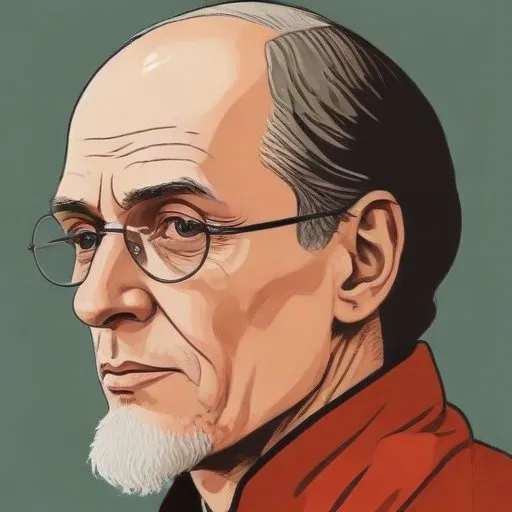
A Russian literary giant who masterfully translated European classics into Russian, while also penning his own romantic poetry that captivated the nation's heart.
Vasily Zhukovsky is renowned for being the leading figure in Russian literature in the first half of the 19th century, introducing the Romantic Movement into Russia, and producing exceptional translations that have become classics of Russian literature.
Born on February 9, 1787, in the village of Mishenskoe, Tula Governorate, Russian Empire, Zhukovsky was the illegitimate son of a landowner Afanasi Bunin and his Turkish housekeeper Salkha. Despite being raised in the Bunin family circle, he was formally adopted by a family friend and took their surname and patronymic.
At the age of 14, Zhukovsky was sent to Moscow to study at the Moscow University Noblemens Pension, where he was heavily influenced by Freemasonry, English Sentimentalism, and German Sturm und Drang. It was during this time that he met Nikolay Karamzin, a prominent Russian man of letters and the founding editor of the literary journal, The Herald of Europe.
Zhukovsky's literary output consists of free translations covering a wide range of poets, from ancient writers like Ferdowsi and Homer to his contemporaries Goethe, Schiller, Byron, and others. Many of his translations have become classics of Russian literature, regarded by some to be better written and more enduring in Russian than in their original languages.
One of his notable works is the free translation of Thomas Gray's "Elegy Written in a Country Churchyard", which was published in 1802 when Zhukovsky was just 19 years old. This work showcased his exceptional skill in translation and his ability to convey the essence of the original text in a new language.
Zhukovsky's contributions to Russian literature are immense. He introduced the Romantic Movement into Russia, paving the way for future generations of Russian writers. His translations not only made European literature accessible to Russian readers but also raised the bar for literary standards in Russia.
As a tutor to the Romanov court, Zhukovsky played a significant role in shaping the literary tastes of the Russian nobility. His influence extended beyond literature, as he was a strong advocate for education and social reform.
Vasily Zhukovsky's legacy is that of a master translator, poet, and literary pioneer. He single-handedly raised the standards of Russian literature, making it a force to be reckoned with in the European literary scene. His translations continue to be celebrated for their beauty, nuance, and attention to detail.
Today, Zhukovsky is remembered as a literary giant, a true son of Russia who left an indelible mark on the country's cultural heritage. His works continue to inspire generations of Russian writers, and his translations remain a testament to his exceptional skill and dedication to the craft.
Born in 1799
Russia's literary icon penned timeless tales of love, drama, and social commentary, leaving an indelible mark on the country's cultural heritage.
Born in 1814
A 19th-century Russian literary giant, known for his poignant poetry and novels that explored the human condition, particularly in the context of Russian society. His works are still widely read and studied today.
Born in 1769
A renowned Russian literary figure, celebrated for his witty and insightful fables that continue to captivate readers of all ages with their timeless wisdom and humor.
Born in 1803
A Russian poet and diplomat who wrote romantic and patriotic poetry that explored the human experience, and served as a diplomat in Germany and Italy.
