


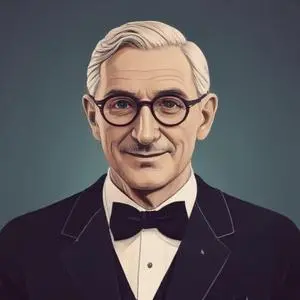
Discoverer of X-rays, revolutionizing medical imaging and diagnostics. This groundbreaking innovation has saved countless lives and transformed the healthcare industry.
Wilhelm Röntgen, a German mechanical engineer and physicist, made history on November 8, 1895, when he produced and detected electromagnetic radiation in a wavelength range known as X-rays or Röntgen rays. This groundbreaking achievement earned him the inaugural Nobel Prize in Physics in 1901 and revolutionized the field of medical imaging.
Röntgen was born on March 27, 1845, in Lennep, Rhine Province, Germany, to Friedrich Conrad Röntgen, a German merchant and cloth manufacturer, and Charlotte Constanze Frowein. At the age of three, his family moved to the Netherlands, where he attended high school at Utrecht Technical School.
Despite being unfairly expelled from high school due to a caricature of one of his teachers, Röntgen persevered and attended Utrecht University as a visitor. He later passed the entrance examination to the Federal Polytechnic Institute in Zurich, where he studied mechanical engineering and graduated with a PhD from the University of Zurich in 1869.
Röntgen's academic career spanned several institutions, including the University of Strasbourg, where he became a lecturer in 1874, and the Academy of Agriculture, where he became a professor in 1875. In 1888, he became the Chair of Physics at the University of Würzburg, where he conducted his pioneering research on X-rays.
Röntgen's most significant contribution was the discovery of X-rays, which he achieved by experimenting with cathode rays and noticing that a fluorescent screen in his lab was glowing even though it was shielded from the cathode rays. He named the unknown radiation "X-rays" and soon realized their potential in medical imaging.
Röntgen's groundbreaking discovery earned him numerous awards and honors, including:
Röntgen's discovery of X-rays revolutionized medical imaging, allowing doctors to visualize internal structures and diagnose diseases more accurately. Today, X-rays are a routine diagnostic tool in hospitals around the world.
In recognition of his contributions, the element 111, roentgenium, was named after him in 2004. The unit of measurement "roentgen" was also named in his honor.
Röntgen married Anna Bertha Ludwig in 1872, and they had no children. He died on February 10, 1923, at the age of 77, leaving behind a legacy that continues to shape the field of medical imaging.
Despite his many achievements, Röntgen remained humble and dedicated to his work, stating, "I did not think I was doing anything of great importance. I was simply trying to solve a problem."
Wilhelm Röntgen's pioneering work on X-rays opened up new possibilities in medical imaging and earned him a place in the annals of scientific history. His legacy continues to inspire researchers and medical professionals around the world.
Born in 1879
A brilliant physicist who developed the theory of relativity and is considered one of the most influential scientists of the 20th century, known for his groundbreaking work in physics and mathematics.
Born in 1867
A pioneering scientist who pioneered radioactivity research, discovering elements polonium and radium, and paving the way for breakthroughs in medicine and energy.
Born in 1856
A pioneering engineer who harnessed the power of alternating current (AC) to transform the world's electrical systems, and is credited with developing groundbreaking technologies like radio communication and X-ray imaging.
Born in 1858
A pioneer in quantum theory, he introduced the concept of the Planck constant, revolutionizing our understanding of energy and matter.
Born in 1901
A pioneer in quantum mechanics, he formulated the uncertainty principle, which revolutionized our understanding of the atomic world. His groundbreaking work reshaped modern physics.
Born in 1892
A French physicist and Nobel laureate who proposed that particles, such as electrons, can exhibit wave-like behavior, revolutionizing quantum mechanics. His hypothesis led to major breakthroughs in understanding the atomic structure.
Born in 1901
A pioneer in nuclear physics, known for leading the team that developed the first nuclear reactor and playing a crucial role in the development of the atomic bomb.
