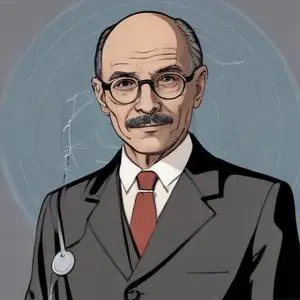
The Heart of Innovation: Willem Einthoven, the Father of Electrocardiography
A Pioneer in Cardiology
Willem Einthoven, a Dutch medical doctor and physiologist, revolutionized the field of cardiology with his groundbreaking invention of the first practical electrocardiograph (ECG or EKG) in 1895. This milestone achievement earned him the Nobel Prize in Physiology or Medicine in 1924, solidifying his position as the father of electrocardiography.
Early Life and Education
Born on May 21, 1860, in Semarang, Java, in the Dutch East Indies (now Indonesia), Einthoven was the son of Louise Marie Mathilde Caroline de Vogel and Jacob Einthoven. His father, a doctor, passed away when Willem was a child, and his mother returned to the Netherlands with her children in 1870, settling in Utrecht. Einthoven's heritage was a rich mix of Jewish, Dutch, and Swiss ancestry.
Einthoven pursued his medical degree at the University of Utrecht, graduating in 1885. His early education laid the foundation for his future contributions to the field of medicine.
Career Highlights
In 1886, Einthoven became a professor at the University of Leiden, marking the beginning of a distinguished academic career. He married his first cousin, Frédérique Jeanne Louise de Vogel, in 1886, and supported her brother Willem through school at Leiden. Einthoven's commitment to education and family was evident in his personal and professional life.
The Breakthrough Invention
Einthoven's most significant contribution came in 1895, when he invented the first practical electrocardiograph (ECG or EKG). This innovative device enabled the accurate measurement of the heart's electrical activity, revolutionizing the diagnosis and treatment of heart conditions.
Before Einthoven's invention, the instruments of the time were unable to accurately measure the electrical currents produced by the heart without placing electrodes directly on the heart. Einthoven's solution was the string galvanometer, a device that used a thin filament of conductive wire passing between strong electromagnets. When a current passed through the filament, the magnetic field created by the current would cause the string to move, casting a shadow on a moving roll of photographic paper, thus forming a continuous curve.
Awards and Honors
Einthoven's groundbreaking work earned him the Nobel Prize in Physiology or Medicine in 1924 for his discovery of the mechanism of the electrocardiogram. This prestigious award recognized his outstanding contribution to the field of cardiology.
Legacy and Impact
Einthoven's invention of the electrocardiograph has had a profound impact on modern medicine, enabling the diagnosis and treatment of heart conditions with unprecedented accuracy. His work paved the way for further research and innovation in cardiology, saving countless lives and improving the quality of life for millions of people worldwide.
Einthoven's legacy extends beyond his scientific contributions, inspiring future generations of researchers, medical professionals, and innovators. His commitment to education, family, and community serves as a testament to the importance of balancing personal and professional life.
Personal Life and Milestones
Einthoven was a devoted family man, supporting his wife's brother through school and building a life together. He became a member of the Royal Netherlands Academy of Arts and Sciences in 1902, a prestigious recognition of his academic achievements.
Einthoven passed away on September 29, 1927, in Leiden, Netherlands, leaving behind a legacy of innovation, education, and community. He is buried in the graveyard of the Reformed Green Church (Groene Kerk) at 6 Haarlemmerstraatweg in Oegstgeest, Netherlands, a place of quiet reflection for those who wish to pay their respects to this medical pioneer.
Trivia and Fun Facts
- Einthoven's father was of Jewish and Dutch descent, while his mother's ancestry was Dutch and Swiss.
- He was the first cousin of his wife, Frédérique Jeanne Louise de Vogel.
- Einthoven's invention of the electrocardiograph was initially met with skepticism, but he persevered, convinced of its potential to revolutionize cardiology.
Inspirational Stories and Motivations
Einthoven's life serves as a testament to the power of innovation, perseverance, and dedication to one's craft. His groundbreaking work in cardiology has saved countless lives, improving the human experience and inspiring future generations of medical professionals and innovators.
FAQ
What was Willem Einthovens role in the development of electrocardiography?
Willem Einthoven was a Dutch physiologist who invented the first practical electrocardiogram (ECG) in 1903, revolutionizing the field of cardiology. He was awarded the Nobel Prize in Physiology or Medicine in 1924.
How did Willem Einthovens invention of the ECG impact medicine?
Einthovens invention of the ECG enabled doctors to diagnose and monitor heart conditions more effectively, saving countless lives and transforming the field of cardiology.
What were Willem Einthovens contributions to physiology?
Einthoven made significant contributions to the field of physiology, including his work on the electrical activity of the heart, nerve physiology, and the physiology of respiration.
What was Willem Einthovens approach to scientific research?
Einthoven was known for his meticulous and thorough approach to scientific research, characterized by his attention to detail and commitment to accuracy.
What is Willem Einthovens legacy in the history of medicine?
Einthovens legacy is one of pioneering innovation, shaping the field of cardiology and physiology forever. His invention of the ECG remains a cornerstone of modern medicine.