


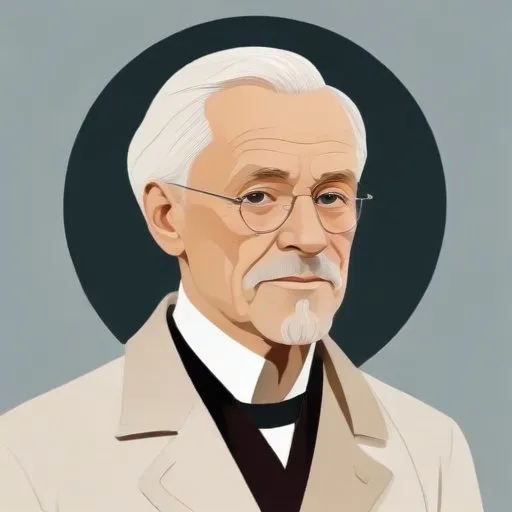
A Dutch physician and academic who discovered that beriberi is caused by a lack of vitamin B in diet, leading to a fundamental shift in the understanding of nutrition and disease. He was awarded the Nobel Prize in Physiology or Medicine in 1929 for his groundbreaking work.
Christiaan Eijkman, a Dutch physician and professor of physiology, is renowned for his groundbreaking discovery that beriberi, a debilitating disease, is caused by a poor diet. This pioneering work led to the identification of antineuritic vitamins, particularly thiamine, and earned him the Nobel Prize for Physiology or Medicine in 1929, alongside Sir Frederick Hopkins.
Born on August 11, 1858, in Nijkerk, Netherlands, Eijkman was the seventh child of Christiaan Eijkman, a school headmaster, and Johanna Alida Pool. His early education took place in Zaandam, where his family moved in 1859. Later, in 1875, he enrolled in the Military Medical School of the University of Amsterdam, where he trained as a medical officer for the Netherlands Indies Army, passing all his examinations with honors.
After completing his studies, Eijkman moved to the Dutch East Indies, where he served as a medical officer of health in various locations, including Semarang, Tjilatjap, and Padang Sidempoean. During his time in Tjilatjap, he contracted malaria, which forced him to return to Europe on sick leave in 1885. This setback turned out to be a blessing in disguise, as it allowed him to work in E. Forster's laboratory in Amsterdam and Robert Koch's bacteriological laboratory.
It was during his research in the Dutch East Indies that Eijkman made the connection between beriberi and diet. He observed that chickens fed on polished rice, devoid of bran, developed symptoms similar to beriberi, while those fed on unpolished rice remained healthy. This discovery led him to conclude that beriberi was caused by a lack of essential nutrients in the diet, rather than an infection.
Eijkman's work on vitamins earned him the Nobel Prize, shared with Sir Frederick Hopkins, in recognition of their discovery of the vitamins essential for human health.
Christiaan Eijkman's pioneering work on vitamins has had a profound impact on our understanding of nutrition and disease prevention. His discovery has saved countless lives and has paved the way for further research into the importance of vitamins in human health.
Eijkman's brother, Johann Frederik Eijkman, was also a chemist, and their father, Christiaan Eijkman, was a school headmaster. Little is known about Eijkman's personal life, but his dedication to his work and his contributions to the field of physiology are a testament to his enduring legacy.
Christiaan Eijkman passed away on November 5, 1930, leaving behind a legacy that continues to inspire researchers and healthcare professionals around the world.
Born in 1843
A pioneering microbiologist and physician who discovered the bacteria that cause tuberculosis, cholera, and anthrax, revolutionizing the field of microbiology and saving countless lives.
Born in 1822
Developed vaccines for rabies and anthrax, and pioneered the germ theory of disease, revolutionizing our understanding of microbiology and disease prevention.
Born in 1854
Developed the first vaccine against diphtheria and tetanus, revolutionizing the treatment of bacterial infections. Pioneered the field of immunology and saved countless lives.
Born in 1852
Pioneering neuroscientist and pathologist who discovered the structure of neurons and pioneered the field of neuroscience, earning a Nobel Prize in Physiology or Medicine in 1906.
Born in 1842
A French astronomer and author who wrote about the wonders of the universe, making astronomy accessible to the general public through his popular science books. He's also known for his work on the possibility of life on other planets.
Born in 1853
Developed the theory of electromagnetism, predicting the existence of radio waves and paving the way for Einstein's theory of relativity. Contributed to the understanding of light, space, and time.
Born in 1865
A Dutch physicist who discovered the Zeeman effect, a phenomenon where spectral lines split into multiple components in a magnetic field, earning him a Nobel Prize in Physics in 1902.
