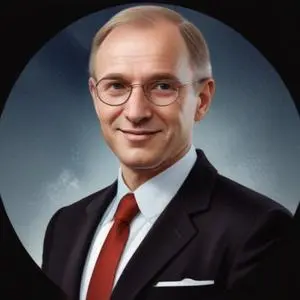
Simon van der Meer: The Innovative Physicist Behind the Discovery of the W and Z Particles
A Nobel Laureate's Legacy in Particle Accelerator Physics
Simon van der Meer, a Dutch particle accelerator physicist, is renowned for his groundbreaking contributions to the CERN project, which led to the discovery of the W and Z particles, the fundamental communicators of the weak interaction. Alongside
Carlo Rubbia, he was awarded the Nobel Prize in Physics in 1984 for his pioneering work in stochastic cooling, a technique that revolutionized the field of particle physics.
Early Life and Education
Born on November 24, 1925, in The Hague, Netherlands, Simon van der Meer was raised in a family of teachers. He graduated from the city's gymnasium in 1943 during the German occupation of the Netherlands. Van der Meer went on to study Technical Physics at the Delft University of Technology, earning an engineer's degree in 1952.
A Career Marked by Innovation and Excellence
Van der Meer's professional career was marked by innovation and excellence. After working for Philips Research in Eindhoven on high-voltage equipment for electron microscopy, he joined CERN in 1956, where he spent the next 34 years. During his tenure at CERN, he designed magnets for the 28 GeV Proton Synchrotron (PS) and invented the Van der Meer horn, a pulsed focusing device used in long-baseline neutrino facilities.
Breakthroughs and Achievements
- Designed a small storage ring for a physics experiment studying the anomalous magnetic moment of the muon.
- Developed a technique for luminosity calibration of colliding beams, first used at the ISR and still used today at the LHC.
- Applied stochastic cooling at CERN in the late 1970s, which led to the discovery of the W and Z particles.
Awards and Honors
In recognition of his outstanding contributions to particle physics, Simon van der Meer received numerous awards and honors, including:
- Nobel Prize in Physics (1984)
- Guthrie Medal and Prize (1976)
- Fellow of the American Physical Society (1984)
Personal Life and Legacy
Simon van der Meer married Catharina M. Koopman in the mid-1960s, and they had a daughter and a son. He was a first cousin once removed of Nobel laureate
Tjalling Koopmans. Van der Meer passed away on March 4, 2011, leaving behind a legacy of innovation and discovery in particle accelerator physics.
Sources:
- CERN
- Nobelprize.org
- American Physical Society
FAQ
What did Simon van der Meer invent?
Simon van der Meer invented a type of stochastic cooling, a technique used to reduce the emittance of particles in an accelerator, which led to the discovery of the W and Z bosons at CERN.
What awards did Simon van der Meer win?
Simon van der Meer was awarded the Noble Prize in Physics in 1984, along with Carlo Rubbia, for their contributions to the discovery of the W and Z bosons.
What was Simon van der Meers role at CERN?
Simon van der Meer was a particle physicist and engineer at CERN, where he worked on several projects, including the development of the Super Proton Synchrotron (SPS) and the Large Electron-Positron Collider (LEP).
What is Simon van der Meers contribution to particle physics?
Simon van der Meers work on stochastic cooling and his contribution to the discovery of the W and Z bosons have had a significant impact on our understanding of particle physics and the Standard Model.
What is Simon van der Meers educational background?
Simon van der Meer studied physics at the University of Amsterdam and later earned his Ph.D. from the University of Utrecht.