


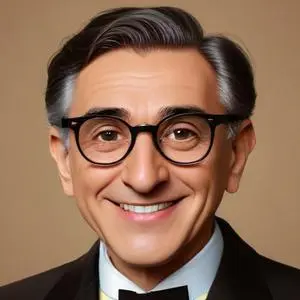
Italian physicist and Nobel laureate who discovered the W and Z bosons, fundamental particles in the universe, and pioneered the use of particle accelerators. He made groundbreaking contributions to our understanding of the universe's fundamental forces.
Carlo Rubbia, a renowned Italian particle physicist, is celebrated for his groundbreaking contributions to the discovery of the W and Z particles at CERN, earning him the Nobel Prize in Physics in 1984, alongside Simon van der Meer. His pioneering work in the field of weak interactions has reshaped our understanding of the fundamental forces of nature.
Born on March 31, 1934, in Gorizia, Italy, Rubbia's fascination with science was sparked by his father, an electrical engineer. Despite initial setbacks, including failing to secure a spot at the Scuola Normale Superiore di Pisa, Rubbia persevered, eventually gaining admission to study physics after a student dropped out. He went on to earn his degree and doctorate in a relatively short span, with a thesis on cosmic ray experimentation under the guidance of Marcello Conversi.
Rubbia's research journey began at Columbia University, where he spent a year and a half conducting experiments on the decay and nuclear capture of muons. This marked the beginning of his extensive work in weak interactions, which would ultimately lead to his Nobel Prize-winning discovery. He later relocated to the University of Rome before joining CERN in 1960, where he delved into experiments on the structure of weak interactions.
Rubbia'sarrival at CERN coincided with the commissioning of the Intersecting Storage Rings, a revolutionary accelerator that utilized counterrotating beams of protons colliding against each other. This cutting-edge technology enabled Rubbia and his collaborators to conduct experiments that would unravel the mysteries of weak interactions. Their findings not only deepened our understanding of the fundamental forces but also paved the way for the discovery of the W and Z particles.
Rubbia's remarkable contributions to physics have been recognized with numerous awards and honors, including:
Rubbia's work has far-reaching implications for our understanding of the universe and the laws that govern it. His discovery of the W and Z particles has opened doors to new areas of research, from particle physics to cosmology. Moreover, his contributions have inspired generations of scientists, fostering a deeper appreciation for the wonders of the natural world.
Rubbia's personal life is marked by his love for his wife, Marisa, whom he met while studying physics at the University of Pisa. Together, they have shared a lifetime of scientific exploration and discovery. Rubbia's legacy extends beyond his groundbreaking research, serving as a testament to the power of human curiosity, perseverance, and collaboration.
84 Years Old
A brilliant mind who unraveled the mysteries of black holes and the universe, making complex physics accessible to all through bestselling books.
Born in 1922
A Nobel Prize-winning physicist and mathematician who discovered the muon neutrino, a subatomic particle, and made significant contributions to our understanding of the universe. His work has far-reaching implications for particle physics and beyond.
97 Years Old
A pioneer in particle physics, discovering subatomic particles like quarks and gluons, and developing the theory of quantum chromodynamics.
Born in 1918
A brilliant physicist and engineer who pioneered quantum mechanics and famously explained complex concepts in simple terms, making science accessible to all.
Born in 1901
A pioneer in nuclear physics, known for leading the team that developed the first nuclear reactor and playing a crucial role in the development of the atomic bomb.
Born in 1867
A pioneering scientist who pioneered radioactivity research, discovering elements polonium and radium, and paving the way for breakthroughs in medicine and energy.
Born in 1879
A brilliant physicist who developed the theory of relativity and is considered one of the most influential scientists of the 20th century, known for his groundbreaking work in physics and mathematics.
Born in 1885
A pioneer in quantum mechanics, he introduced the concept of wave-particle duality, revolutionizing our understanding of atomic structure. His philosophical approach to science also explored the nature of reality and human understanding.
