


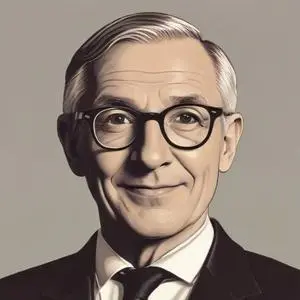
A pioneer in the field of econometrics, he developed models to analyze economic systems and optimize resource allocation, earning him the Nobel Prize in Economics. His work has had a lasting impact on modern economic theory and policy-making.
Tjalling Koopmans is renowned for his groundbreaking work on the theory of optimum allocation of resources, which earned him the 1975 Nobel Memorial Prize in Economic Sciences alongside Leonid Kantorovich. His pioneering efforts led to significant breakthroughs in understanding how to optimize resource allocation, revolutionizing the field of economics.
Koopmans was born on August 28, 1910, in 's-Graveland, Netherlands. At just 17, he began his university education at Utrecht University, where he initially specialized in mathematics. Three years later, he shifted his focus to theoretical physics, eventually meeting Jan Tinbergen, the 1969 Nobel Memorial Prize winner in Economics, who inspired him to pursue mathematical economics.
Koopmans' most notable contribution is his work on the theory of optimum allocation of resources, which demonstrated that certain efficiency criteria can be used to make important deductions concerning optimum price systems. This breakthrough led to significant improvements in resource allocation and planning.
Koopmans' contributions to economics were recognized with numerous awards and honors, including:
Koopmans' work has had a profound impact on modern economics, influencing policymakers, academics, and business leaders worldwide. His theories have been applied in various fields, including:
Koopmans moved to the United States in 1940 and became a naturalized citizen in 1946. He passed away on February 26, 1985, leaving behind a rich legacy in the field of economics. His work continues to inspire new generations of economists, researchers, and policymakers.
Born in 1920
Developed econometric models that accurately predicted economic trends and fluctuations, earning him the Nobel Prize in Economics in 1980.
Born in 1915
A renowned economist and academic who made significant contributions to the field of economics, particularly in the areas of macroeconomics and international trade. He was awarded the Nobel Prize in Economics in 1970.
Born in 1912
A Nobel Prize-winning economist who championed free market capitalism and limited government intervention, known for his advocacy of laissez-faire economics and influential writings on monetary policy.
Born in 1883
A pioneering economist who revolutionized modern economic theory with his groundbreaking ideas on government intervention and fiscal policy, shaping global economic policies.
92 Years Old
A renowned economist and philosopher who has made significant contributions to welfare economics, social choice theory, and development economics, and is known for his work on poverty, famine, and human development.
83 Years Old
A Nobel Prize-winning economist and academic who has made significant contributions to the field of economics, particularly in the areas of information economics and globalization.
86 Years Old
A Nobel Prize-winning economist who developed the concept of "information asymmetry," which explains how unequal access to information affects markets and transactions. His work has far-reaching implications for understanding economic behavior and policy-making.
Born in 1924
A Nobel Prize-winning economist who developed a growth model that showed technological progress is the primary driver of economic growth, and is known for his work on the theory of economic growth.
