


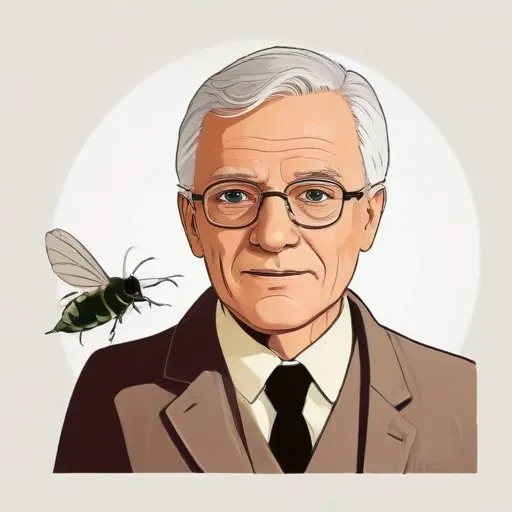
Developed the concept of phylogenetic systematics, a method of classifying organisms based on their evolutionary relationships, revolutionizing the field of biology.
Willi Hennig, a German biologist and zoologist, is renowned for founding phylogenetic systematics, also known as cladistics. His groundbreaking work revolutionized the understanding of the natural order of beings, transforming the field of systematics and evolutionary biology.
Hennig was born on April 20, 1913, in Drrhennersdorf, Upper Lusatia, Germany. His mother, Marie Emma, worked as a maid and factory worker, while his father, Karl Ernst Emil Hennig, was a rail worker. Willi had two brothers, Fritz Rudolf Hennig, who became a minister, and Karl Herbert, who went missing at the Battle of Stalingrad in 1943.
During his time as a prisoner of war in 1945, Hennig began developing his theory of cladistics. He published his work in German in 1950, and a substantially revised English translation followed in 1966. This foundational work introduced key concepts, such as synapomorphy, symplesiomorphy, and paraphyly, which have since become cornerstones of phylogenetic systematics.
Hennig's most notable work, Grundzüge einer Theorie der phylogenetischen Systematik, published in 1950, laid the foundation for modern cladistics. His revised English translation, Phylogenetic Systematics, appeared in 1966 and has since become a seminal work in the field.
Hennig's ideas have permeated various fields, from evolutionary biology to paleontology and ecology. His work has inspired new approaches to understanding the natural world, influencing popular culture through documentaries, films, and literature.
Hennig received numerous awards and honors for his contributions to science, including the Balzan Prize in 1969 and the Linnean Medal in 1974.
Willi Hennig's legacy extends far beyond his own lifetime, shaping the trajectory of phylogenetic systematics and inspiring generations of scientists. His work continues to influence our understanding of the natural world, and his ideas remain a cornerstone of modern evolutionary biology.
Hennig's story serves as a testament to the power of human curiosity and ingenuity, reminding us that even in the darkest of times, groundbreaking ideas can emerge, transforming our understanding of the world and our place within it.
Born in 1904
A renowned biologist and ornithologist who pioneered the modern synthesis of evolutionary biology, shaping our understanding of species and their diversity.
Born in 1707
Developed the system of binomial nomenclature, which is still used today to classify and name living organisms. This system has had a profound impact on the fields of biology, ecology, and conservation.
Born in 1744
A French soldier, biologist, and academic who developed a theory of inheritance of acquired characteristics, proposing that organisms adapt to their environment and pass on those traits to their offspring.
Born in 1769
Founded the field of comparative anatomy, establishing extinction as a fact and creating a framework for understanding the natural world through fossil records.
Born in 1809
Developed the theory of evolution through natural selection, revolutionizing our understanding of life on Earth. This groundbreaking idea transformed the fields of biology, ecology, and beyond.
