


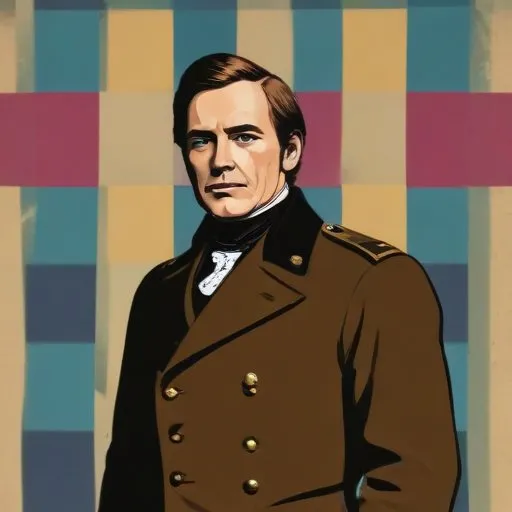
American soldier, explorer, and politician who led the Corps of Discovery expedition with Meriwether Lewis, mapping the western wilderness and opening up new territories for settlement. He later served as the 4th Governor of Missouri Territory.
William Clark, a name etched in the annals of American history, is famously known for leading the Lewis and Clark Expedition, a daring venture that spanned from 1804 to 1806, traversing over 7,000 miles of uncharted territory to the Pacific Ocean. This monumental journey not only explored the vast expanse of the Louisiana Purchase but also solidified American claims to the Pacific Northwest.
Born on August 1, 1770, in Caroline County, Virginia, Clark grew up in a family of planters, with English and possibly Scots ancestry. Despite lacking formal education, he was tutored at home and developed a strong sense of curiosity and adventure. His military career began at a young age, serving in the Virginia militia and later in the United States Army.
In 1803, Clark joined forces with Meriwether Lewis, and together they embarked on an epic expedition to explore the newly acquired Louisiana Territory. With a party of 33 people, including a Native American woman, Sacagawea, they navigated treacherous terrain, forged alliances with Native American tribes, and mapped the unknown territories. The expedition's findings greatly expanded American knowledge of the region, paving the way for future settlement and development.
Following the expedition, Clark continued to serve in the militia and later as the governor of the Missouri Territory. From 1822 until his death in 1838, he held the position of Superintendent of Indian Affairs, working tirelessly to promote understanding and cooperation between the U.S. government and Native American tribes.
Clark's personal life was marked by his love of nature and his strong sense of loyalty to his country. He was known for his convoluted grammar and inconsistent spelling, which often led to humorous corrections from his colleagues. Despite these quirks, Clark's writing style and vocabulary revealed his love of literature and poetry.
Clark's legacy extends far beyond his incredible journey with Lewis. He played a pivotal role in shaping America's westward expansion, facilitating the country's growth, and fostering a deeper understanding of its indigenous peoples. Today, Clark is celebrated as a visionary explorer, a champion of American progress, and an advocate for harmony between cultures.
Clark's journey was a testament to American ambition and curiosity. His bravery, leadership, and diplomatic skills paved the way for future explorers, settlers, and statesmen. Today, his name is synonymous with American exploration, and his legacy continues to inspire generations of historians, scientists, and adventurers.
Clark's expedition coincided with other notable explorers of the time, including Zebulon Pike and Alexander MacKenzie. While each explorer had their own unique contributions, Clark's journey stands out for its sheer scale, geographic significance, and cultural implications.
Clark's bond with Meriwether Lewis remains one of the most enduring partnerships in American history. The two men shared a deep friendship, forged through their shared experiences and mutual respect. Their journey together is a testament to the power of collaboration and camaraderie.
Clark's story serves as a beacon of inspiration, reminding us of the importance of perseverance, curiosity, and cultural understanding. His journey continues to captivate our imagination, encouraging us to explore, to discover, and to push beyond the boundaries of human knowledge.
Born in 1774
Led the Corps of Discovery expedition with William Clark, mapping the western United States and establishing trade with Native American tribes. Known for his bravery, leadership, and contributions to American exploration and expansion.
Born in 1743
The principal author of the Declaration of Independence and a strong advocate for individual liberties and limited government, shaping America's foundational principles. He oversaw the Louisiana Purchase, doubling the country's territory.
Born in 1763
A German-American mogul who built a fur trading empire and invested in real estate, amassing a vast fortune, which he later used to support the arts and education.
Born in 1771
Sergeant and author who participated in the Lewis and Clark Expedition, documenting their journey and providing valuable insights into the exploration of the American West.
Born in 1752
Led a military campaign to capture the Northwest Territory from the British during the American Revolutionary War, securing a vast region for the young United States.
Born in 1734
Legendary frontiersman and trailblazer who explored and settled the American West, famously leading settlers through the Cumberland Gap.
Born in 1779
Led expeditions to explore and map the American West, including the discovery of Pikes Peak, and played a key role in the War of 1812.
