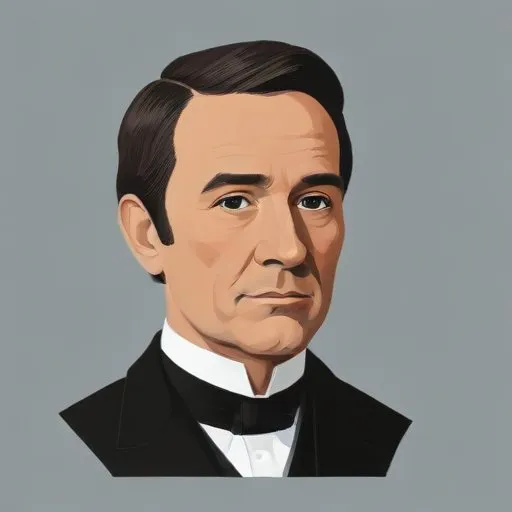
William H. Prescott: The Pioneering Historian Who Illuminated the Spanish Empire
A Legacy of Rigorous Scholarship and Engaging Narrative
William H. Prescott is widely regarded as the first American scientific historian, renowned for his meticulous research and captivating writing style. His groundbreaking works on the Spanish Empire, particularly the reigns of Ferdinand and Isabella, the conquest of Mexico, and the conquest of Peru, have left an indelible mark on the field of historiography.
A Life of Perseverance and Intellectual Curiosity
Born on May 4, 1796, in Salem, Massachusetts, Prescott was the first of seven children. Despite struggling with serious visual impairment, which often prevented him from reading or writing for himself, he developed an extraordinary eidetic memory. This unique ability enabled him to recall vast amounts of information, a skill that would serve him well in his future academic pursuits.
The Development of a Historian
Prescott's interest in history was sparked during his time at Harvard University, where he was deeply influenced by the works of European historians. After graduating in 1814, he embarked on a period of extensive study, during which he sporadically contributed to academic journals. It was during this time that he became fascinated with late Renaissance Spain and the early Spanish Empire, a subject that would become the focal point of his life's work.
Major Works and Contributions
Prescott's magnum opus,
The History of the Reign of Ferdinand and Isabella the Catholic (1837), marked a significant milestone in the field of historiography. This work, followed by
The History of the Conquest of Mexico (1843) and
A History of the Conquest of Peru (1847), demonstrated his unparalleled mastery of archival research and narrative storytelling. His unfinished work,
History of the Reign of Phillip II (1856-1858), remains a testament to his unwavering dedication to his craft.
A Leader in the Development of History as a Discipline
During his lifetime, Prescott was revered as one of the greatest living American intellectuals. He maintained close relationships with prominent political figures in both the United States and Britain, including President
John Quincy Adams and British historian William H. Lecky. Prescott's commitment to rigorous scholarship and his systematic use of archives helped establish history as a respected academic discipline.
Influence on Modern Society and Historiography
Prescott's works have had a profound impact on the study of both Spain and Mesoamerica. His writings have been translated into numerous languages, making him one of the most widely read American historians. His influence extends beyond academia, as his engaging narrative style has inspired generations of historians, writers, and scholars.
Personal Milestones and Key Life Events
- Graduated from Harvard University in 1814
- Published The History of the Reign of Ferdinand and Isabella the Catholic in 1837
- Published The History of the Conquest of Mexico in 1843
- Published A History of the Conquest of Peru in 1847
- Began work on History of the Reign of Phillip II in 1856
- Passed away on January 28, 1859
Legacy and Historical Context
William H. Prescott's remarkable life and works have left an enduring legacy in the field of historiography. As a pioneering figure in American historical scholarship, his commitment to rigorous research, engaging narrative, and intellectual curiosity continues to inspire scholars and historians to this day.
FAQ
What was William H. Prescotts contribution to American historiography?
William H. Prescott was a pioneering historian who wrote comprehensive and engaging histories of the Spanish Empire, shedding light on the Conquest of Mexico and the reign of the Spanish monarchs.
What is William H. Prescotts most famous work?
William H. Prescotts most famous work is The History of the Conquest of Mexico, a seminal work that explores the Spanish conquest of the Aztec Empire and its aftermath.
What was William H. Prescotts approach to historical writing?
William H. Prescott was known for his meticulous research, engaging narrative style, and objectivity, which set a new standard for historical writing in the United States.
What was William H. Prescotts academic background?
William H. Prescott graduated from Harvard University, where he developed his passion for history and began his research on the Spanish Empire.
When did William H. Prescott live?
William H. Prescott lived from 1796 to 1859, a period marked by significant cultural and intellectual developments in the United States.