


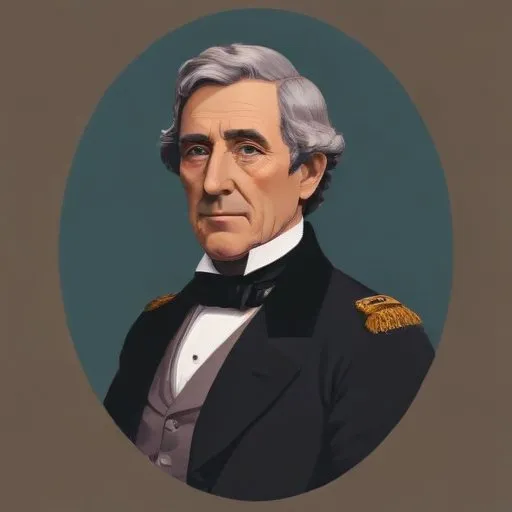
Son of the famous Secretary of State, he was a Union general during the American Civil War and later a prominent banker, known for his military bravery and financial acumen.
William H. Seward Jr. is perhaps best known as the son of William H. Seward, the United States Secretary of State under Abraham Lincoln and Andrew Johnson, but his own contributions to American history are nothing short of remarkable. As a banker, brigadier general in the Union Army, and devoted public servant, Seward Jr. left an indelible mark on the nation during one of its most tumultuous periods.
Born on June 18, 1839, in Auburn, New York, Seward Jr. was the youngest son of the prominent politician and his wife, Frances Adeline Seward. His father, a governor and later senator, had just taken office when Seward Jr. was born, and his mother was the daughter of Judge Elijah Miller, a law partner of Seward Sr. who had built the family home in Auburn in 1816.
Seward Jr.'s regiment served in the defenses of Washington, D.C. until it was converted back to an infantry regiment and sent to the Army of the Potomac due to the losses sustained by that army in the Overland Campaign. After fighting at the Battle of Cold Harbor, Seward Jr. was appointed colonel of the regiment on June 10, 1864.
A few weeks after his promotion to colonel, Seward Jr.'s regiment was sent north to meet the threat to Washington, D.C. posed by Confederate Lieutenant General Jubal Early's Valley Campaigns of 1864. Seward Jr. was slightly wounded in his arm and suffered a broken leg when his horse fell on him after the horse was shot at the Battle of Monocacy on July 9, 1864.
William H. Seward Jr.'s bravery and dedication to public service are a testament to his family's legacy of patriotism and commitment to the nation. Despite facing personal challenges and the tumultuous nature of the Civil War era, Seward Jr. remained steadfast in his duty, serving as an inspiration to his comrades and later generations of Americans.
Today, Seward Jr.'s contributions to American history serve as a reminder of the sacrifices made by countless individuals who fought for the Union and shaped the nation's future. His story is a powerful testament to the importance of public service, personal courage, and the enduring spirit of American patriotism.
Born in 1801
The 24th United States Secretary of State played a crucial role in shaping America's foreign policy, particularly in the acquisition of Alaska from Russia in 1867. He's also known for his strong anti-slavery stance.
Born in 1822
Led the Union Army to victory in the Civil War and later became President, known for issuing the Emancipation Proclamation and strengthening federal authority.
Born in 1809
Led the United States through its Civil War and ultimately abolished slavery, leaving a lasting legacy in American history.
45 Years Old
A dominant wide receiver in the NFL, known for his athleticism, sure hands, and impressive career statistics, earning him seven Pro Bowl selections.
Born in 1808
The 6th Chief Justice of the United States, a strong advocate for slavery abolition and a key player in shaping the country's financial system, particularly during the Civil War era.
Born in 1826
A Union general during the American Civil War, he's infamous for his cautious tactics and disagreements with President Lincoln, later becoming a governor of New Jersey.
