


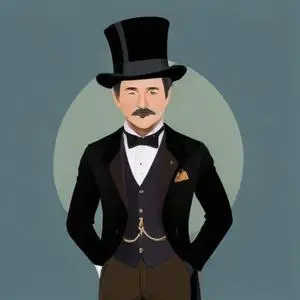
A wealthy railroad magnate and generous donor, he expanded his family's railroad empire and supported various educational and cultural institutions.
William Henry Vanderbilt, also known as Billy, was an American businessman and philanthropist who inherited his father's vast fortune and expanded it to become the wealthiest American of his time. He took over his father's business empire in 1877 and doubled the family's wealth in less than nine years, leaving behind a substantial legacy.
Vanderbilt was born on May 8, 1821, in New Brunswick, New Jersey, to Commodore Cornelius Vanderbilt and Sophia Johnson. His father, a successful businessman, was known for his strict and critical nature, often belittling his son, calling him a "blockhead" and a "blatherskite."
Vanderbilt's business career began at the age of 19 as a clerk in a New York banking house. He worked his way up the corporate ladder, becoming the president of the Staten Island Railway in 1862 and vice-president of the Hudson River railway in 1865. In 1869, he became the vice-president of the New York Central and Hudson River Railroad, and in 1877, he took over as its president.
After his father's death in 1877, Vanderbilt inherited his vast empire, including the Lake Shore and Michigan Southern Railway, the Canada Southern Railway, and the Michigan Central Railroad. He expanded his railroad holdings to include the Chicago, Burlington, and Quincy Railroad, among others.
Vanderbilt's relationship with his father was complex and often tumultuous. Despite his father's criticism, Vanderbilt longed to prove himself, and a turning point came during a family trip to Europe in 1860. The trip brought the two closer, and Vanderbilt began to play a greater role in the family business.
Vanderbilt married Maria Louisa Kissam in 1843, and they had eight children together. He was known for his philanthropic efforts, particularly in the area of education, and was a generous donor to several institutions, including Vanderbilt University.
Vanderbilt inherited nearly $100 million from his father, and by the time of his death in 1885, the family's fortune had doubled to approximately $200 million. He was the richest American of his time, and his wealth had a significant impact on the American economy.
Vanderbilt's legacy is deeply ingrained in American history. He played a crucial role in the development of the American railroad industry, and his philanthropic efforts continue to benefit educational institutions to this day. Despite his father's initial doubts, Vanderbilt proved himself to be a shrewd businessman and a worthy successor to his father's empire.
Vanderbilt's life and career serve as a testament to the American Dream, a rags-to-riches story that continues to inspire generations. His life's work has left an indelible mark on American history, and his legacy continues to shape the country's economic and social landscape.
Born in 1794
Built railroad empires, revolutionizing transportation and commerce, and donated extensively to education and the arts.
Born in 1836
A ruthless and cunning financier who dominated the railroad industry in the late 19th century, known for his clever business tactics and questionable ethics.
Born in 1837
Founded a powerful banking dynasty and dominated corporate finance, shaping the American economy through strategic investments and mergers.
Born in 1835
A self-made industrialist who amassed a vast fortune in the steel industry, then donated most of it to fund over 2,500 public libraries and other philanthropic endeavors.
Born in 1839
Founded the Standard Oil Company, revolutionizing the oil industry and amassing vast wealth, which he later used for philanthropic efforts. He's remembered for his business acumen and generosity.
Born in 1853
Developed groundbreaking inventions and innovations in electrical engineering, including the first practical welding machine and the first electric streetcar system.
Born in 1846
Developed innovative braking systems for trains, revolutionizing rail safety and transforming the industry. Founded a company that dominated the market for over a century.
