


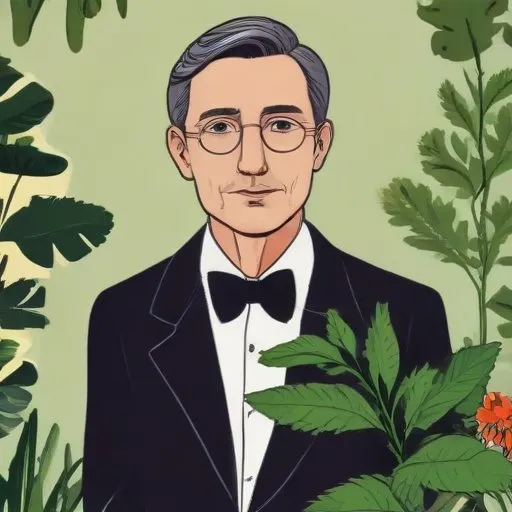
A British botanist and academic who contributed significantly to the field of botany, particularly in the classification and description of plant species. His work laid the foundation for future botanical research.
Sir William Jackson Hooker, a trailblazing English botanist, is renowned for his pivotal role in transforming the Royal Botanic Gardens, Kew, into a world-class institution. His groundbreaking work as the first director of Kew, which began in 1841, led to the establishment of the Herbarium and a significant expansion of the gardens and arboretum.
Born on July 6, 1785, in Norwich, England, Hooker's fascination with botany was ignited by his inheritance, which allowed him to travel and dedicate himself to the study of natural history. His expeditions took him to Iceland, where he published an account of his journey in 1809, despite losing his notes and specimens during the voyage home.
Hooker's academic pursuits led him to become the Regius Professor of Botany at Glasgow University, where he collaborated with botanist and lithographer Thomas Hopkirk and enjoyed the support of Joseph Banks. In 1841, he succeeded William Townsend Aiton as Director of the Royal Botanic Gardens, Kew, a position that would become the pinnacle of his career.
During his tenure at Kew, Hooker oversaw the construction of new glasshouses, the establishment of an arboretum, and the creation of a museum of economic botany. These initiatives cemented Kew's reputation as a hub for botanical research and education.
Hooker's literary contributions to the field of botany are multifaceted. Notable publications include:
Hooker married Maria, the eldest daughter of Norfolk banker Dawson Turner, in 1815, and the couple had a son, Joseph Dalton Hooker, who would later succeed his father as Director of Kew Gardens. Hooker's legacy extends beyond his academic achievements, as he was a devoted husband, father, and friend, cherished by his contemporaries.
Sir William Jackson Hooker passed away on August 12, 1865, due to complications from a throat infection. He was laid to rest at St Annes Church, Kew. His remarkable contributions to botany and Kew Gardens have been recognized through various honors, including the standard author abbreviation "Hook." in botanical nomenclature.
Hooker's tireless efforts to promote botanical research, education, and conservation have left an indelible mark on the scientific community. As a testament to his legacy, the Royal Botanic Gardens, Kew, remains a thriving institution, inspiring generations of botanists, researchers, and enthusiasts worldwide.
Born in 1743
A British naturalist who sailed with Captain Cook on the HMS Endeavour, discovering and cataloging thousands of plant species, and advising on the development of the British colonies. He's considered the "father of Australian botany".
41 Years Old
A Welsh rugby union player who captained Wales and the British and Irish Lions, known for his exceptional skill and leadership on the pitch.
Born in 1817
A renowned botanist and explorer who contributed significantly to the discovery and classification of numerous plant species, particularly in the Himalayas and Antarctica. His work laid the foundation for modern botanical research.
Born in 1810
A pioneering botanist who contributed significantly to the development of American botany, particularly in the fields of plant classification and evolution.
Born in 1809
Developed the theory of evolution through natural selection, revolutionizing our understanding of life on Earth. This groundbreaking idea transformed the fields of biology, ecology, and beyond.
