


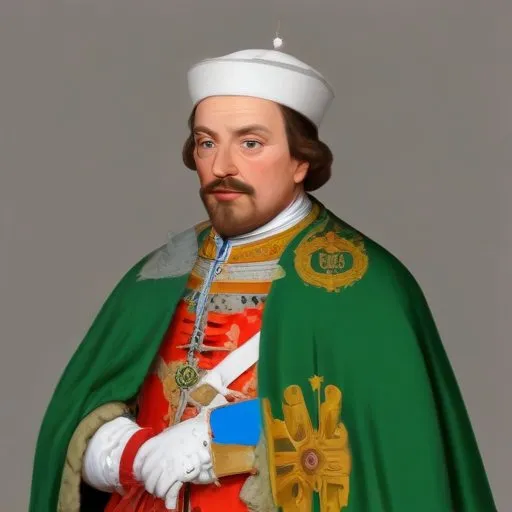
A 13th-century German nobleman who ruled Meissen and played a key role in the development of the region, known for his military campaigns and territorial expansions.
William I, also known as William the One-Eyed, was a 14th-century German nobleman who left an indelible mark on the region of Meissen. As the Margrave of Meissen, he ruled with a clever and strategic mind, securing significant territories, defending against powerful houses, and patronizing the arts.
Born on December 19, 1343, in Dresden, William was the son of Frederick II, Margrave of Meissen, and Mathilde of Bavaria. He began his reign alongside his brothers and father, eventually securing the Margraviate of Meissen through the Division of Chemnitz in 1382.
William's administrative prowess and diplomatic skills earned him the respect of his peers and the admiration of his people. He successfully governed the region, strengthening his position by acquiring the rule of Colditz and the possessions of the Burgraviate of Dohna.
William's cultural contributions were just as impressive as his political achievements. He was a great patron of the Meissen Cathedral, where he successfully enforced the exemption of the cathedral's privileges. His love for architecture led him to found the Augustinian Monastery in Dresden in 1404, which he endowed with generous possessions.
William married twice, first to Elizabeth of Moravia, who passed away in 1400, and then to Anna of Brunswick, daughter of Otto I of Brunswick. Unfortunately, both marriages remained childless, and his inheritance fell to his nephews, Frederick the Peaceful, Frederick the Belligerent, and William the Rich.
Despite his passing on February 9, 1407, at Schloss Grimma, William's legacy endured. His clever management of powers, strategic alliances, and cultural patronage shaped the region of Meissen and left a lasting impact on the German nobility.
In an era marked by power struggles and territorial disputes, William's leadership stood out for its prudence and vision. While his contemporaries, such as the Luxembourg dynasty, were embroiled in conflicts, William worked towards securing his position and strengthening his region.
Through his remarkable achievements and far-sighted vision, William I, Margrave of Meissen, left an indelible mark on the history of the region and the German nobility. His story serves as a testament to the power of strategic thinking, cultural patronage, and effective leadership.
Born in 1310
Ruler of Meissen from 1323 to 1349, known for his military campaigns and territorial expansions, establishing Meissen as a powerful state in the Holy Roman Empire.
Born in 1310
Ruler of Meissen from 1323 to 1349, known for his military campaigns and territorial expansions, establishing Meissen as a powerful state in the Holy Roman Empire.
Born in 1343
A 13th-century German nobleman who ruled Meissen and played a key role in the development of the region, known for his military campaigns and territorial expansions.
Born in 1310
Ruler of Meissen from 1323 to 1349, known for his military campaigns and territorial expansions, establishing Meissen as a powerful state in the Holy Roman Empire.
