


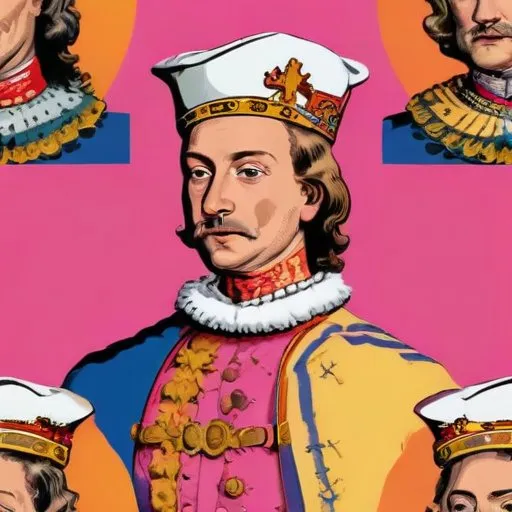
Ruler of Meissen from 1323 to 1349, known for his military campaigns and territorial expansions, establishing Meissen as a powerful state in the Holy Roman Empire.
Frederick II, Margrave of Meissen, was a powerful and influential leader of the Margraviate of Meissen, a region in modern-day Germany. He is known for his bold attempts to consolidate power, his declaration of peace in 1338, and his involvement in the Thuringian Counts War.
Born on November 30, 1310, in Gotha, Frederick II was the son of Margrave Frederick I of Meissen and Elisabeth von Lobdeburg-Arnshaugk. He succeeded his father as Margrave of Meissen and Thuringia in 1323, under the guardianship of his mother.
Upon reaching the age of majority in 1329, Frederick II took control of the margraviate and faced numerous challenges from vassals and neighbors. His declaration of peace in 1338, aimed at subjugating local rulers and small landlords, sparked widespread resistance. The Thuringian Counts War, which lasted from 1342 to 1346, was a direct result of this conflict.
Frederick II married Mathilde of Bavaria, daughter of Louis IV, Holy Roman Emperor, in 1323. The couple had nine children, including Elisabeth, Frederick III, Landgrave of Thuringia, Balthasar, Beatrice, Louis, William the One-eyed, and Anne.
Frederick II's legacy is marked by his efforts to centralize power and control in the Margraviate of Meissen. His declaration of peace, although controversial, demonstrated his commitment to unifying the region under his rule. Additionally, his involvement in the Thuringian Counts War showcased his determination to defend his territory against rival claimants.
Frederick II's reign occurred during a period of significant upheaval in the Holy Roman Empire. His refusal to accepts the German crown, offered by the Bavarian party after the death of Emperor Louis IV, highlights his cautious approach to expansion and consolidation. Ultimately, his meeting with Charles IV in 1348, where they recognized the existing possession states, demonstrated his ability to navigate complex political relationships.
Frederick II's legacy continues to influence the region's history, serving as a testament to the complex politics and power struggles of the medieval period.
Born in 1370
First German ruler to be elected as Holy Roman Emperor, he played a crucial role in shaping the Holy Roman Empire and its relations with the Church. He's known for his diplomatic and military prowess.
Born in 1441
German ruler of Saxony who introduced the Reformation and played a key role in the early Protestant movement, shaping the course of European history.
Born in 1471
A 15th-century German nobleman who ruled Saxony and was a key figure in the early Protestant Reformation, supporting Martin Luther's ideas and protecting him from persecution. He's also known for his cultural achievements, including commissioning artworks and founding the University of Wittenberg.
Born in 1468
A key figure in the Protestant Reformation, he played a crucial role in establishing Lutheranism in Germany and was a strong supporter of Martin Luther. He's also known for his military campaigns against the Holy Roman Empire.
Born in 1463
A key figure in the early Protestant Reformation, he protected and supported Martin Luther, providing a safe haven for him to translate the Bible into German. He's also known for his role in establishing the University of Wittenberg.
Born in 1503
Elector of Saxony who played a key role in the Protestant Reformation and was a prominent leader of the Schmalkaldic League, a defensive alliance of Protestant states. He's also known for being captured and imprisoned by Emperor Charles V.
Born in 1521
A 16th-century German ruler who played a key role in the Protestant Reformation and was a skilled military leader, known for his cunning and diplomacy. He was a significant figure in the complex web of alliances and conflicts of the time.
