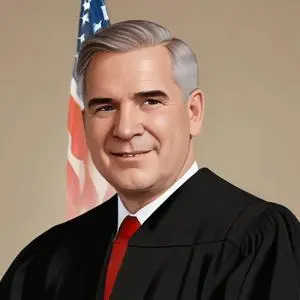
Justice William J. Brennan Jr.: A Champion of Progressive Values
A Legacy of Liberal Leadership
William J. Brennan Jr. is revered as one of the most influential justices in the history of the United States Supreme Court. During his 34-year tenure, he consistently championed liberal values, earning him the reputation as the leader of the Court's liberal wing.
Early Life and Education
Born on April 25, 1906, in Newark, New Jersey, Brennan developed an early interest in economics, studying the subject at the University of Pennsylvania. He later attended Harvard Law School, where he honed his legal skills and developed a passion for social justice.
Rise to Prominence
Brennan's legal career began in private practice in New Jersey, where he quickly made a name for himself as a skilled attorney. During World War II, he served in the U.S. Army, an experience that would later shape his views on social justice. In 1951, he was appointed to the Supreme Court of New Jersey, where he served until his appointment to the U.S. Supreme Court in 1956.
A Supreme Court Justice
President
Dwight D. Eisenhower appointed Brennan to the Supreme Court using a recess appointment, a move that was confirmed by the Senate the following year. Brennan's tenure on the Court was marked by his unwavering commitment to liberal principles, earning him the respect of his peers and the admiration of the American people.
Landmark Decisions
Brennan authored numerous landmark opinions, including:
- Baker v. Carr (1962): Establishing the justiciability of legislative district apportionment
- New York Times Co. v. Sullivan (1964): Requiring actual malice in libel suits brought by public officials
- Eisenstadt v. Baird (1972): Establishing a legal right to contraception for unmarried individuals
- Craig v. Boren (1976): Subjecting laws that discriminate on the basis of sex to heightened scrutiny under the Equal Protection Clause
Influence and Legacy
Justice Brennan's impact on the Supreme Court and American society cannot be overstated. He dissented in over 1,400 cases involving the death penalty, passionately arguing against its constitutionality. His commitment to abortion rights and gay rights helped shape the Court's stance on these critical issues.
Personal Milestones and Key Life Events
Brennan's personal life was marked by his marriage to Marjorie Leonard, with whom he had three children. He was known for his humble and unassuming nature, often preferring to avoid the spotlight in favor of focusing on his work.
Historical Context and Comparative Analysis
Brennan's tenure on the Supreme Court spanned a transformative period in American history, from the Civil Rights Movement to the Women's Liberation Movement. His liberal philosophy and commitment to social justice placed him in stark contrast to his more conservative colleagues, such as Justice
Antonin Scalia, who would later praise Brennan as "probably the most influential Justice of the 20th century."
Awards and Honors
Throughout his illustrious career, Brennan received numerous awards and honors, including the Presidential Medal of Freedom, the highest civilian honor in the United States.
Impact on Modern Society
Justice Brennan's legacy extends far beyond the Court's chambers. His commitment to liberal values and social justice has inspired generations of lawyers, judges, and social activists. His influence can be seen in the many landmark decisions that have shaped American society, from reproductive rights to civil liberties.
FAQ
What was William J. Brennan Jr.s career like on the Supreme Court?
William J. Brennan Jr. served as an Associate Justice of the Supreme Court of the United States from 1957 to 1990, becoming one of the longest-serving justices in history. He was a liberal champion of individual rights and civil liberties, playing a key role in shaping the Courts progressive agenda.
How did William J. Brennan Jr. interpret the Constitution?
Brennan was known for his flexible and adaptive approach to constitutional interpretation, often relying on the living Constitution theory. He believed that the Constitutions meaning should evolve over time to reflect changing societal values and needs.
What were William J. Brennan Jr.s most notable Supreme Court opinions?
Brennan wrote several landmark opinions, including Baker v. Carr (1962), which established the principle of one person, one vote, and New York Times Co. v. Sullivan (1964), which protected freedom of the press. He also played a key role in decisions on issues like affirmative action, abortion, and capital punishment.
Did William J. Brennan Jr. have any notable relationships with other justices?
Yes, Brennan was known for his close relationships with other liberal justices, including Earl Warren and Thurgood Marshall. He often worked behind the scenes to build coalitions and persuade his colleagues to support progressive causes.
What is William J. Brennan Jr.s legacy on the Supreme Court?
Brennans legacy is that of a champion of individual rights and civil liberties, who played a crucial role in shaping the Supreme Courts progressive agenda during the mid-20th century. His opinions and influence continue to shape American law and politics today.