


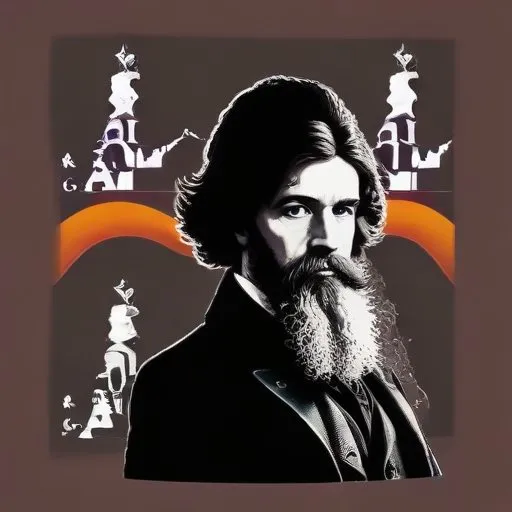
Developed groundbreaking theories in thermodynamics and formulated the Rankine cycle, a fundamental concept in mechanical engineering. His work revolutionized the design of steam engines and paved the way for modern power generation.
William John Macquorn Rankine was a Scottish engineer, physicist, and mathematician who revolutionized the field of thermodynamics, earning him the title of "the Father of Thermodynamics." His groundbreaking work in the mid-19th century laid the foundation for modern refrigeration, air conditioning, and power generation.
Born on July 5, 1820, in Edinburgh, Scotland, Rankine was the son of a civil engineer. He was educated at Ayr Academy and the University of Edinburgh, where he excelled in mathematics and physics. In 1838, he joined his father's engineering firm, where he worked on various projects, including the design of bridges and canals.
Rankine's most significant contributions came during the 1840s and 1850s, when he conducted comprehensive research on the properties of gases and vapors. His work led to the development of the Rankeine cycle, a thermodynamic cycle that describes the behavior of ideal gases. This cycle is still used today in the design of power plants, refrigeration systems, and air conditioning units.
Rankine's other major works include:
Rankine was deeply interested in the philosophical implications of his work. He believed that the laws of thermodynamics had profound implications for our understanding of the universe and the nature of energy. He saw thermodynamics as a fundamental aspect of the natural world, governing the behavior of all physical systems.
In 1855, Rankine was appointed as the Regius Professor of Civil Engineering and Mechanics at the University of Glasgow, a position he held until his death in 1872. During his tenure, he established the Glasgow School of Engineering, which became a hub for innovation and research in the field.
Rankine was also an accomplished musician and composer. He wrote several songs and orchestral pieces, including a cantata that was performed at the Glasgow Musical Festival in 1862.
Rankine's work has had a profound impact on modern society. His development of the Rankine cycle has enabled the widespread adoption of refrigeration and air conditioning, revolutionizing the way we live and work. Additionally, his research on thermodynamics has contributed to the development of more efficient power generation systems, reducing our reliance on fossil fuels and mitigating climate change.
Rankine's contributions to thermodynamics were recognized during his lifetime. He was elected a Fellow of the Royal Society in 1853 and awarded the Keith Medal in 1854. Today, he is remembered as one of the most important figures in the history of thermodynamics, and his work continues to inspire scientists and engineers around the world.
Rankine was known for his sense of humor and wit. He was a popular lecturer and was often dubbed the "Steam Engine Poet" due to his ability to explain complex concepts in simple, poetic language.
Rankine died on December 24, 1872, at the age of 52, leaving behind a legacy of innovation and discovery that continues to shape our world today.
Born in 1831
Developed groundbreaking theories that unified electricity and magnetism, and predicted the existence of radio waves, revolutionizing our understanding of the physical world.
Born in 1736
Improved steam engine efficiency, revolutionizing industry and transportation. Known for his innovative designs and patents that transformed the Industrial Revolution.
Born in 1806
A visionary engineer who revolutionized transportation with innovative designs, including the iconic Clifton Suspension Bridge, which transformed urban landscapes.
Born in 1791
Pioneering scientist who discovered electromagnetic induction, formulated the laws of electrolysis, and invented the first electrical generator, revolutionizing our understanding of electricity and its applications.
Born in 1778
Pioneering chemist and physicist who discovered several elements, including potassium and sodium, and invented the Davy lamp, a safety lamp for miners. His groundbreaking work laid the foundation for modern chemistry and electrochemistry.
