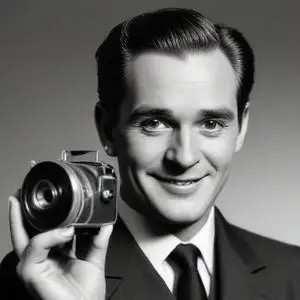
The Pioneer of Motion Pictures: William Kennedy Dickson
A Revolutionary Inventor and Film Innovator
William Kennedy Dickson, a British inventor, is renowned for devising an early motion picture camera under the employment of
Thomas Edison, a pioneering achievement that paved the way for the film industry as we know it today. In the late 19th century, Dickson's innovative spirit and technical expertise transformed the world of entertainment, making him a trailblazer in the realm of motion pictures.
A Life of Curiosity and Exploration
Born on August 3, 1860, in Le Minihicsur-Rance, Brittany, France, to Elizabeth Kennedy-Laurie and James Waite Dickson, a Scottish artist, astronomer, and linguist, William's early life was marked by a sense of wonder and curiosity. His father, who claimed direct lineage from the painter
William Hogarth and Judge
John Waite, instilled in him a passion for art, science, and innovation.
The Quest for Employment and Innovation
At the age of 19, Dickson wrote a letter to Thomas Edison seeking employment, but was initially turned down. Undeterred, he moved to Virginia with his mother and sisters in 1879. Four years later, he joined Edison's laboratory in Menlo Park, New Jersey, where he began his remarkable journey as an inventor and film innovator.
The Birth of Motion Pictures
In 1888, Edison conceived the idea of a device that would "do for the eye what the phonograph does for the ear." Dickson, as Edison's official photographer, was tasked with turning this concept into a reality. After experimenting with microphotographs on a cylinder, Dickson collaborated with the Eastman company to develop a practical celluloid film, eventually settling on 35mm film with a 1.33:1 picture ratio, a standard format still in use today.
A Legacy of Innovation and Contribution
Dickson's groundbreaking work on motion pictures not only paved the way for the film industry but also left an indelible mark on popular culture. His contributions to the development of cinematography, film editing, and special effects continue to inspire filmmakers and innovators around the world.
Personal Milestones and Key Life Events
- 1860: Born on August 3rd in Le Minihicsur-Rance, Brittany, France
- 1879: Moved to Virginia with his mother and sisters
- 1883: Joined Edison's laboratory in Menlo Park, New Jersey
- 1888: Developed the concept of motion pictures with Thomas Edison
- 1889: Collaborated with the Eastman company to develop celluloid film
- 1935: Passed away on September 28th
Influence on Modern Society
William Kennedy Dickson's pioneering work on motion pictures has had a profound impact on modern society, shaping the way we tell stories, entertain, and communicate. His innovative spirit and technical expertise have inspired generations of filmmakers, inventors, and innovators, leaving an indelible mark on popular culture.
Farewell to a Visionary
William Kennedy Dickson's remarkable life and legacy serve as a testament to the power of human ingenuity, creativity, and innovation. As we look back on his remarkable journey, we are reminded of the profound impact one individual can have on the world, and the enduring legacy of a true pioneer.
FAQ
What were William Kennedy Dicksons contributions to early cinema?
William Kennedy Dickson was a pioneer of early cinema, working with Thomas Edison to develop the kinetograph, and producing the first film strips and motion pictures.
How did William Kennedy Dicksons work with Thomas Edison influence early cinema?
William Kennedy Dicksons collaboration with Thomas Edison led to the development of the first motion picture cameras, paving the way for the growth of the film industry.
What were William Kennedy Dicksons achievements as a director and producer?
William Kennedy Dickson directed and produced numerous films, including documentaries, dramas, and newsreels, contributing to the evolution of cinematic storytelling and technique.
How did William Kennedy Dicksons French-Scottish heritage influence his career?
William Kennedy Dicksons French-Scottish heritage exposed him to diverse cultural and artistic influences, shaping his approach to filmmaking and his contributions to early cinema.
What is William Kennedy Dicksons legacy in the history of cinema?
William Kennedy Dicksons legacy is that of a pioneering figure in early cinema, innovating film technology, and laying the groundwork for the development of the film industry.