


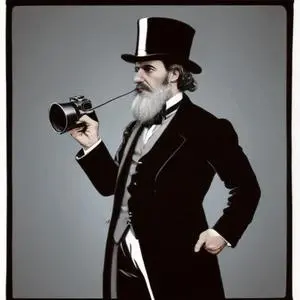
Pioneering photographer and cinematographer who created the first motion pictures, capturing sequences of animal and human movement in a series of still images. Known for his groundbreaking work in motion photography and its influence on the development of film.
Eadweard Muybridge, a name synonymous with innovation and creativity, is widely regarded as one of the most influential photographers of the 19th century. He is best known for his groundbreaking work in photographic studies of motion, laying the foundation for the development of motion pictures.
Born Edward James Muggeridge on April 9, 1830, in Kingston upon Thames, Surrey, England, Muybridge adopted the name Eadweard, believing it to be the original Anglo-Saxon form of Edward. He immigrated to the United States at the age of 20, where he initially worked as a bookseller in New York City and later in San Francisco.
In 1860, Muybridge's life took a dramatic turn when he suffered serious head injuries in a stagecoach crash in Texas. During his recuperation in Kingston upon Thames, he discovered his passion for photography, learning the wet-plate collodion process and securing two British patents for his inventions. This transformative experience marked the beginning of his remarkable journey as a photographer.
Muybridge's work as a photographer earned him widespread recognition, particularly for his iconic photographs of Yosemite Valley, which he exhibited in 1868. His stunning stereographs became extremely popular, and he continued to travel extensively, capturing the beauty of the American West, Alaska, and Central America.
Muybridge's most significant contribution to the world of photography came in the late 1870s, when he developed chronophotography, a technique that used multiple cameras to capture the different stages of animal locomotion. He also invented the zoopraxiscope, a device that projected painted motion pictures from glass discs, predating the modern film strip. This pioneering work paved the way for the development of motion pictures.
In 1874, Muybridge was involved in a highly publicized scandal, shooting and killing his wife's lover, Major Harry Larkyns. He was acquitted of murder charges, citing justifiable homicide. This event would forever tarnish his reputation, but it did not diminish his impact on the world of photography.
Eadweard Muybridge's innovative work in photography and motion studies has had a lasting impact on modern society. His contributions to the development of motion pictures, zoology, and the art of photography continue to inspire generations of artists, scientists, and innovators. Today, Muybridge is recognized as a true pioneer, and his work remains a testament to his boundless creativity and ingenuity.
Through his remarkable life and work, Eadweard Muybridge continues to captivate audiences, leaving an indelible mark on the world of photography and beyond.
Born in 1847
A pioneer in innovation, credited with developing groundbreaking inventions that revolutionized the way people live and communicate, including the light bulb and phonograph.
Born in 1860
Pioneering filmmaker credited with inventing the first practical motion picture camera and producing the first film, "Blacksmith Scene." He paved the way for the development of modern cinema.
Born in 1830
Pioneering chronophotography, capturing movement and motion in a series of photographs, revolutionizing the study of human and animal locomotion. Known for inventing the chronophotographic gun, a camera that could take 12 images per second.
Born in 1855
Pioneering filmmaker and cinematographer credited with inventing the first practical motion picture camera, producing early films, and developing techniques still used today.
Born in 1854
Founded the company that revolutionized photography by making it accessible and affordable to the masses through innovative film and camera technologies. Known for pioneering the development of roll film and the first point-and-shoot camera.
