


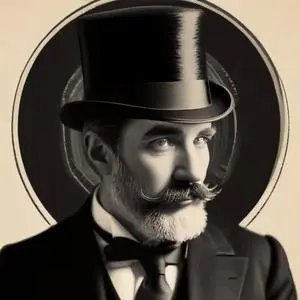
Pioneering chronophotography, capturing movement and motion in a series of photographs, revolutionizing the study of human and animal locomotion. Known for inventing the chronophotographic gun, a camera that could take 12 images per second.
Étienne-Jules Marey, a French scientist, physiologist, and chronophotographer, is renowned for his groundbreaking work in the development of cardiology, physical instrumentation, aviation, cinematography, and the science of laboratory photography.
Born on March 5, 1830, in Beaune, Côte-d'Or, Marey's fascination with the human body led him to pursue a career in medicine. He shifted his focus to analyzing heart beats, respiration, muscles, and movement of the body, developing innovative instruments for precise measurements.
Marey's collaboration with Auguste Chauveau and the watch manufacturer Breguet in 1859 resulted in the development of a wearable Sphygmograph, an improvement on an earlier design by Karl von Vierordt. This instrument enabled precise measurement of the pulse, paving the way for significant advancements in cardiology.
In 1869, Marey constructed an artificial insect to demonstrate the figure-eight shape produced during the movement of its wings. He employed a gold foil attached to an insect wing and shone light on it to study the flapping of the wing. This experiment led to a deeper understanding of the aerodynamics of insect flight.
Marey's fascination with movements of air and bigger flying animals, such as birds, led him to adopt and further develop animated photography into a separate field of chronophotography in the 1880s. His revolutionary idea was to record several phases of movement on one photographic surface.
In 1890, Marey published a substantial volume titled Le Vol des Oiseaux, showcasing his chronophotographic techniques. This work laid the foundation for the development of cinematography, earning Marey recognition as a pioneer of the history of cinema.
Marey's contributions to the fields of cardiology, aviation, and cinematography are immeasurable. His pioneering work in chronophotography paved the way for the development of modern cinema, influencing the likes of Émile Cohl and Eadweard Muybridge.
His graphical techniques for displaying and interpreting quantitative data from physiological measurements have had a lasting impact on the scientific community. Marey's work has inspired generations of scientists, photographers, and filmmakers, cementing his position as a visionary in the history of innovation.
Little is known about Marey's personal life, but his dedication to his work and his passion for scientific discovery are evident in his numerous publications and inventions. Marey's legacy extends beyond his scientific contributions, as his work has inspired a sense of wonder and curiosity in people around the world.
Marey passed away on May 15, 1904, in Paris, leaving behind a legacy that continues to inspire and influence scientists, filmmakers, and photographers to this day.
Born in 1775
French physicist and mathematician who discovered the polarization of light and developed the theory of partial reflection, making significant contributions to the field of optics.
Born in 1786
A mathematician and politician who made significant contributions to the development of electromagnetism and served as Prime Minister of France, advocating for social reform and education.
Born in 1819
Developed the method of measuring the speed of light using a rotating wheel with teeth, and was the first to accurately measure the speed of light in 1849.
Born in 1788
Discovered the phenomenon of radioactivity, pioneering the field of nuclear physics and earning a Nobel Prize in 1903.
Born in 1822
Developed vaccines for rabies and anthrax, and pioneered the germ theory of disease, revolutionizing our understanding of microbiology and disease prevention.
Born in 1813
Pioneering physiologist who introduced the concept of homeostasis, revolutionizing our understanding of the human body's internal balance and its response to environmental changes.
Born in 1852
Discovered radioactivity, a fundamental property of atoms, and pioneered research in the field, leading to breakthroughs in medicine, energy, and materials science.
Born in 1859
A pioneer in radioactivity research, discovering elements like polonium and radium, and pioneering radioactive isolation techniques. Their groundbreaking work paved the way for advancements in medicine, energy, and materials science.
