


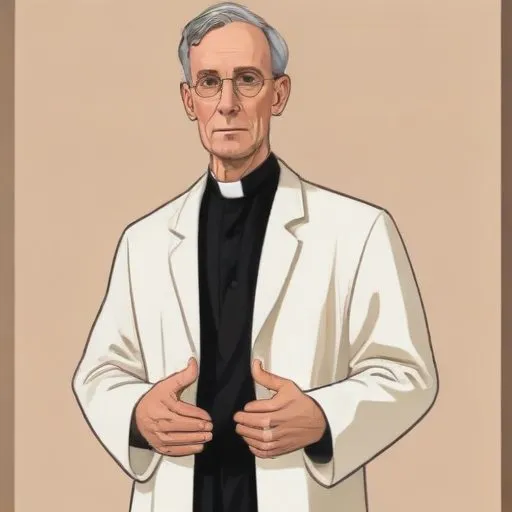
An English priest and entomologist who made significant contributions to the field of entomology, particularly in the study of insects and their classification. He wrote several influential books on the subject, including "A Monograph on the British Entomology".
William Kirby, an English entomologist and country rector, is renowned for his groundbreaking contributions to the field of entomology, particularly through his co-authored four-volume work, Introduction to Entomology, with William Spence. This influential publication cemented his position as a leading figure in the scientific community, earning him recognition as a Fellow of the Royal Society.
Kirby was born on 19 September 1759 in Witnesham, Suffolk, to William Kirby, a solicitor, and Lucy Meadows. He came from a family of accomplished individuals, including his grandfather, John Kirby, a topographer, and his nephew, Sarah Trimmer, a children's author. Kirby studied at Ipswich School and later attended Caius College, Cambridge, where he graduated in 1781.
Taking holy orders in 1782, Kirby spent his entire working life in the peaceful seclusion of an English country parsonage at Barham in Suffolk. He worked at the parish church of St Mary's for 68 years, first as curate, then as rector from 1797. This unique blend of clerical duties and scientific pursuits earned him the title of "parson-naturalist."
Kirby's interest in natural history was sparked by Nicholas Gwynn, a friend of Boerhaaves, who introduced him to Sir James Edward Smith in 1791. He soon became corresponding with Smith, seeking advice on the foundation of a natural history museum at Ipswich. Among his early friends were the naturalists Charles Sutton and Thomas Marsham, with whom he made lengthy scientific excursions.
Kirby produced his first major work, the Monographia Apum Angliae (Monograph on the Bees of England), in 1802. This publication showcased his meticulous research and scientific expertise, establishing him as a leading authority in the field of entomology. His co-authored Introduction to Entomology, with William Spence, remains one of his most influential works, widely recognized for its significance in the history of entomology.
Kirby's exceptional contributions to science earned him a place among the original list of Fellows of the Linnean Society. He delivered numerous papers on various scientific topics, including his inaugural paper on "Three New Species of Hirudo Linn." in 1793.
William Kirby's remarkable achievements in entomology, coupled with his dedication to his clerical duties, have left an indelible mark on the scientific community. As a pioneering parson-naturalist, he paved the way for future generations of scientists to explore the fascinating world of insects, solidifying his position as a prominent figure in the history of entomology.
Born in 1885
Led the country through World War II, implementing policies to defend Australia and its economy. He's also known for his leadership during the country's transition from British to American influence.
Born in 1805
A pioneering entomologist and archaeologist who made significant contributions to the fields of insect classification and ancient artifact discovery. Known for his groundbreaking work on British insects and his excavations in Egypt and Greece.
Born in 1825
A British explorer who traveled to the Amazon rainforest and discovered over 8,000 species, including butterflies, beetles, and birds, and is known for his theory of mimicry in nature.
Born in 1823
A pioneering naturalist who discovered evolution through natural selection, independently of Charles Darwin, and contributed significantly to the field of biogeography.
Born in 1809
Developed the theory of evolution through natural selection, revolutionizing our understanding of life on Earth. This groundbreaking idea transformed the fields of biology, ecology, and beyond.
