


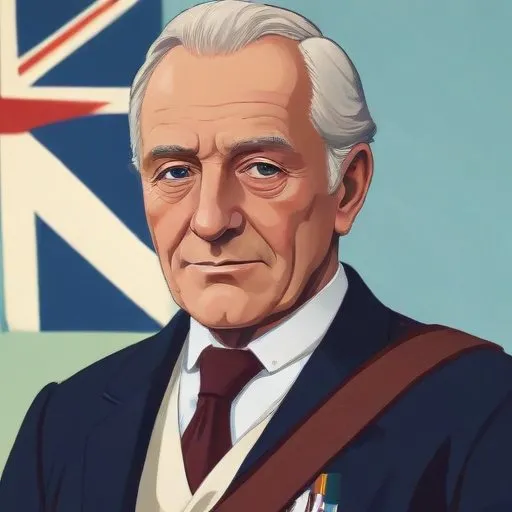
Early Australian settler and politician who played a key role in the exploration and development of New South Wales, particularly in the Hunter Valley region.
William Lawson, a British soldier, explorer, and politician, is best known for being part of the first successful crossing of the Blue Mountains by British colonists, alongside Gregory Blaxland and William Wentworth. This groundbreaking feat in 1813 opened up new territories for settlement and cemented Lawson's place in Australian history.
Born on June 2, 1774, in Finchley, Middlesex, England, Lawson was the son of John Lawson and his second wife, Hannah Summers. His father's successful chandler business and Scottish heritage, tracing back to the Lawson family of Cairnmuir House in Edinburgh, Scotland, likely influenced Lawson's adventurous spirit.
Lawson received his education in London and trained as a surveyor before joining the British Army as an ensign in the New South Wales Corps in 1799. He was posted to Sydney, arriving in November 1800, where he would eventually rise to the rank of lieutenant.
Shortly after his arrival in Sydney, Lawson was sent to Norfolk Island, where he worked under Major Joseph Foveaux at the penal colony. During this time, he became embroiled in the suppression of an Irish convict and soldier uprising, which led to the hanging of two alleged ringleaders and the punishment of others with 500 lashes.
Lawson's trustworthiness earned him a role in the island's military court, which was later accused of corrupt practices. He also acquired land and raised sheep on the island, and began a long-term relationship with Sarah Leadbeater, a convict mistress who would eventually become his wife and the mother of his eleven children.
In 1813, Lawson, along with Blaxland and Wentworth, embarked on the historic Blue Mountains expedition. The trio set out on May 11, 1813, and reached the top of the mountains on May 31, 1813, after traversing over 100 miles of rugged terrain. This achievement marked the first time European settlers had successfully crossed the Blue Mountains, paving the way for further exploration and settlement.
Lawson married Sarah Leadbeater in 1812, and the couple had eleven children together. He died on June 16, 1850, leaving behind a legacy as a pioneering explorer and a testament to the enduring spirit of adventure.
William Lawson's remarkable life, marked by bravery, exploration, and pioneering spirit, continues to inspire Australians and history enthusiasts alike, solidifying his place as one of the most significant figures in early Australian history.
Born in 1815
A Scottish explorer and surveyor who led the first successful expedition to cross Australia from south to north, opening up the continent to further exploration and settlement.
Born in 1813
A German-born explorer who led several expeditions in Australia, mapping new territories and discovering natural wonders, including the discovery of the Darling River.
