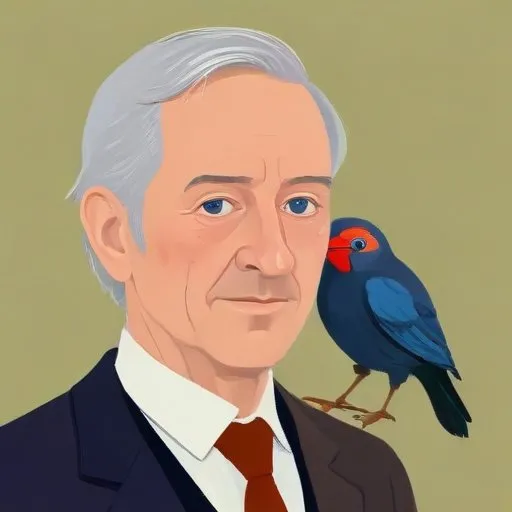
William MacGillivray: The Scottish Naturalist Who Revolutionized Ornithology
A Legacy of Observation and Discovery
William MacGillivray, a Scottish naturalist, and ornithologist, is renowned for his groundbreaking contributions to the field of ornithology. His meticulous observations and scientifically rigorous work on birds have had a lasting impact on our understanding of these fascinating creatures.
Early Life and Education
Born on January 25, 1796, in Old Aberdeen, Scotland, MacGillivray was raised on the island of Harris. He pursued his passion for natural history at King's College, Aberdeen, where he graduated with an MA in 1815. His academic pursuits led him to become an assistant dissector in anatomy classes, laying the foundation for his future endeavors in natural history.
A Notable Career
MacGillivray's career took off when he became an assistant to Robert Jameson, the Regius Professor of Natural History at the University of Edinburgh. This opportunity allowed him to hone his skills and develop his expertise in ornithology. In 1831, he became the curator of the museum of the Royal College of Surgeons of Edinburgh, a position he held until 1841. During this period, he worked closely with the American bird expert
John James Audubon, contributing significantly to Audubon's monumental work,
Ornithological Biographies.
Contributions to Ornithology
MacGillivray's most notable achievement was his work on distinguishing between the hooded crow and carrion crow, a distinction that would remain uncontested for over a century. His observations and research laid the groundwork for the eventual recognition of the hooded crow as a distinct species in 2002, based on DNA evidence.
Friendship and Collaboration
MacGillivray's friendship with John James Audubon was a significant factor in his success. Audubon, in turn, honored MacGillivray by naming a bird species, MacGillivray's warbler, in his honor.
Personal Life and Legacy
MacGillivray married Marion Askill from Harris in 1820, and they had 10 children together. Two of his sons, John and Paul, followed in his footsteps, becoming naturalists in their own right. Paul MacGillivray published an Aberdeen Flora in 1853 and donated 214 of his father's paintings to the Natural History Museum.
Works and Publications
Some of MacGillivray's notable works include:
- Lives of Eminent Zoologists from Aristotle to Linnaeus
In Memoriam
William MacGillivray passed away on September 4, 1852, at the age of 67. He was buried in New Calton Cemetery, Edinburgh, where his grave remains a testament to his life's work.
Today, MacGillivray's contributions to ornithology continue to inspire and educate generations of naturalists and scientists. His legacy serves as a reminder of the power of observation, dedication, and collaboration in advancing our understanding of the natural world.
FAQ
What was William MacGillivrays most notable contribution to ornithology?
William MacGillivrays most notable contribution to ornithology was his publication of the five-volume A History of British Birds, which provided detailed descriptions of bird species and their habitats.
What was William MacGillivrays role in the development of ornithology as a scientific field?
William MacGillivray played a significant role in the development of ornithology as a scientific field, as he applied scientific principles to the study of birds and their behavior.
What was William MacGillivrays views on conservation and wildlife preservation?
William MacGillivray was a strong advocate for conservation and wildlife preservation, and he believed in the importance of protecting bird habitats and preventing species extinction.
How did William MacGillivrays work influence the development of ecology?
William MacGillivrays work on bird habitats and ecosystems had a significant impact on the development of ecology as a scientific field, as it highlighted the importance of studying the relationships between species and their environments.
What was William MacGillivrays most notable achievement as a naturalist?
William MacGillivrays most notable achievement as a naturalist was his ability to combine scientific observation with literary skill, making his writings accessible to a wide range of audiences.