


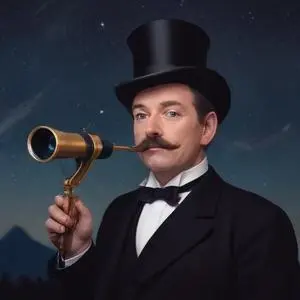
Built a massive telescope to study the universe, discovering several nebulas and making significant contributions to astronomy.
William Parsons, 3rd Earl of Rosse, is renowned for building the largest telescope of his time, the Leviathan of Parsonstown, and making significant contributions to the field of astronomy. As an Irish astronomer, naturalist, and engineer, Parsons' work had a profound impact on our understanding of the universe, earning him the presidency of the Royal Society and a place in the annals of scientific history.
Born on June 17, 1800, in York, England, Parsons was the son of Sir Lawrence Parsons, later 2nd Earl of Rosse, and Alice Lloyd. He received his education at Trinity College Dublin and Magdalen College, Oxford, graduating with first-class honors in mathematics in 1822.
Parsons' passion for astronomy led him to construct several giant telescopes, including the Leviathan of Parsonstown, which was built in 1845 and held the record for the world's largest telescope in terms of aperture size until the early 20th century. This monumental instrument enabled Parsons to make significant discoveries, including the observation of the Whirlpool Galaxy (M51) and the detection of the Crab Nebula.
Parsons' contributions to astronomy were instrumental in shaping our understanding of the universe. His legacy extends beyond his scientific accomplishments, as he also played a significant role in promoting education and scientific inquiry. As president of the Royal Society, he worked tirelessly to advance the cause of science and foster a culture of innovation.
Parsons married Mary Field, daughter of John Wilmer Field, on April 14, 1836, and had thirteen offspring, of which four sons survived to adulthood. His sons went on to achieve distinction in their respective fields, with Lawrence becoming the 4th Earl of Rosse, Randal becoming a reverend, Richard developing railways in South America, and Charles inventing the steam turbine.
William Parsons, 3rd Earl of Rosse, was a visionary who pushed the boundaries of human knowledge and understanding. His contributions to astronomy, education, and innovation continue to inspire future generations of scientists and thinkers. His legacy serves as a testament to the power of human ingenuity and the importance of pursuing knowledge and discovery.
In conclusion, William Parsons, 3rd Earl of Rosse, was a true giant in the world of science and astronomy. His groundbreaking work on the Leviathan of Parsonstown telescope, his presidency of the Royal Society, and his numerous achievements in various fields have cemented his place in history. As we continue to explore the vast expanse of the universe, we would do well to remember the pioneering spirit and innovative legacy of William Parsons, 3rd Earl of Rosse.
Born in 1564
Pioneering astronomer, physicist, and mathematician who played a major role in the Scientific Revolution, making key discoveries that challenged Aristotelian views and laid the foundation for modern science.
Born in 1571
A 17th-century trailblazer who discovered the three laws of planetary motion, revolutionizing our understanding of the solar system. He's also credited with being a pioneer in the field of astrology.
Born in 1546
A 16th-century astronomer who made precise measurements of the stars and planets, laying the foundation for modern astronomy. His data helped Kepler discover planetary orbits.
Born in 1473
A Renaissance-era mathematician and astronomer who proposed the heliocentric model, where the Sun is at the center of our solar system, revolutionizing our understanding of the universe.
Born in 1561
A 16th-17th century Renaissance figure who pioneered the scientific method and empiricism, and served as a prominent government official.
Born in 1596
Developed influential philosophical and mathematical concepts, including the famous phrase "I think, therefore I am," and laid the foundation for modern Western philosophy.
Born in 1623
A 17th-century genius who made major contributions to mathematics, physics, and philosophy, inventing the mechanical calculator and developing the theory of probability. His writings also explored the human condition and faith.
Born in 1656
Predicted celestial events, including the return of a comet that bears his name, and made significant contributions to navigation, astronomy, and mathematics.
