


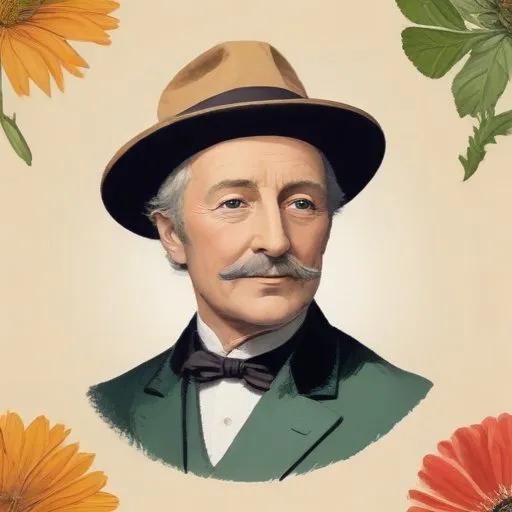
English botanist who contributed significantly to the field of botany, particularly in the discovery and classification of new plant species.
William Sherard was a renowned English botanist of the 17th and 18th centuries, known for his groundbreaking contributions to the field of taxonomy and his instrumental role in shaping the work of prominent botanists, including Carolus Linnaeus, the father of modern taxonomy. His tireless efforts in cataloging and classifying plant species have left an indelible mark on the world of botany, earning him a place among the most influential botanists of his time.
Sherard was born on February 27, 1659, in Bushby, Leicestershire, England, to a humble family. Despite his modest upbringing, he was driven to succeed and pursued higher education at St. John's College, Oxford, where he studied from 1677 to 1683. This marked the beginning of his journey into the world of botany.
Sherard's fascination with botany led him to Paris, where he studied under the renowned botanist Joseph Pitton de Tournefort from 1686 to 1688. During this period, he befriended and learned from Paul Hermann, a fellow student of Tournefort's. This friendship would later prove instrumental in shaping Sherard's career. Hermann, who was based in Leyden, Netherlands, introduced Sherard to the works of prominent botanists, further fueling his passion for the subject.
In 1690, Sherard became a tutor to the family of Sir Arthur Rawdon at Moira, County Down, Ireland. This position allowed him to hon his skills and gather valuable knowledge, which he would later use to great effect. In 1703, he was appointed British Consul at Smyrna, a position he held until 1716. It was during this period that he accumulated a substantial fortune, which he would later use to support fellow naturalists and endorse the publication of influential botanical works.
Sherard's generosity and patronage had a profound impact on the world of botany. He sponsored the publication of Sebastien Vaillant's Botanicon parisiense (1727) and Hermann's Musaeum zeylanica. Additionally, he endowed the Chair of Botany at Oxford University, with the stipulation that it be awarded to Johann Jacob Dillenius, a fellow botanist and friend. This bequest led to the establishment of the Sherardian Professorship of Botany, which continues to this day. In recognition of his contributions, the University of Oxford awarded him a doctorate in medicine in 1731.
Sherard's work had far-reaching consequences, paving the way for later botanists, including Carolus Linnaeus. His contributions to the field of taxonomy helped establish a standardized system of classification, which remains a cornerstone of modern botany. Through his patronage and philanthropy, Sherard supported a network of botanists, ensuring the continuation of botanical research and discovery.
In conclusion, William Sherard's remarkable life and achievements serve as a testament to the power of dedication, hard work, and generosity. His legacy continues to inspire and influence botanists to this day, cementing his place as one of the most important figures in the history of botany.
Born in 1707
Developed the system of binomial nomenclature, which is still used today to classify and name living organisms. This system has had a profound impact on the fields of biology, ecology, and conservation.
82 Years Old
A German-Canadian singer-songwriter, guitarist, and producer, known for his eclectic style blending rock, folk, and blues, and as the frontman of the rock band Steppenwolf. He's famous for hits like "Born to Be Wild" and "Magic Carpet Ride".
Born in 1743
A British naturalist who sailed with Captain Cook on the HMS Endeavour, discovering and cataloging thousands of plant species, and advising on the development of the British colonies. He's considered the "father of Australian botany".
Born in 1744
A French soldier, biologist, and academic who developed a theory of inheritance of acquired characteristics, proposing that organisms adapt to their environment and pass on those traits to their offspring.
Born in 1759
Founded the Linnean Society, a prestigious organization dedicated to the study and dissemination of taxonomy and natural history, and made significant contributions to the fields of botany and mycology.
Born in 1715
A prominent 18th-century English polymath who made significant contributions to the fields of medicine, physics, and botany, particularly in the discovery of the circulation of blood. He also wrote extensively on electricity and botany.
