


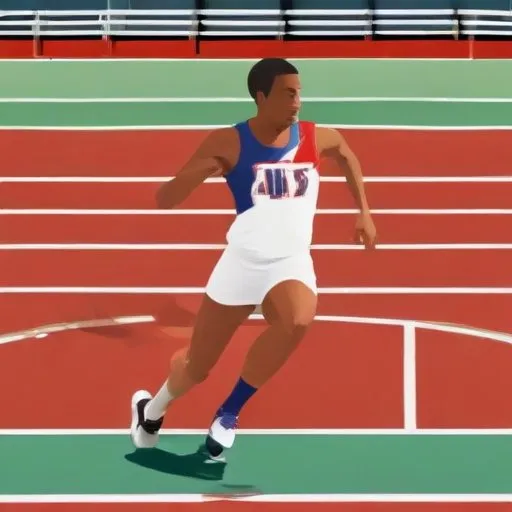
American track and field athlete who won gold medals in the 400-meter hurdles at the 1924 Paris Olympics and set multiple world records. He was a dominant force in his event during the 1920s.
William Stevenson was an American track and field athlete, lawyer, and diplomat who made a lasting impact in multiple fields. He is best known for winning the gold medal in the 4x400 meters relay at the 1924 Summer Olympics and later serving as the president of Oberlin College.
Born on October 25, 1900, in Chicago, Illinois, Stevenson demonstrated exceptional athletic prowess from an early age. He won the AAU championships in the 440-yard dash in 1921, which earned him a place on the American track and field team for the 1924 Summer Olympics.
Stevenson was a graduate of Andover and Princeton University, where he excelled in academics and athletics. He was awarded a Rhodes Scholarship to Oxford University, where he studied law and honed his intellectual skills.
In 1924, Stevenson participated in the Paris Olympics, where he ran the second leg of the 4x400 meters relay team that won the gold medal with a new world record of 3:16.0. This historic achievement cemented his place in the annals of American athletic history.
After returning to the United States, Stevenson pursued a successful legal career. In the 1920s, he served as an assistant U.S. attorney for the southern district of New York. In 1931, he co-founded the prominent New York law partnership of Debevoise, Stevenson, Plimpton, and Page, which is now Debevoise & Plimpton LLP.
During World War II, Stevenson and his wife, Eleanor Bumpie Bumstead Stevenson, played a crucial role in organizing and administering American Red Cross operations in Great Britain, North Africa, Sicily, and Italy. Both Stevenson and his wife were awarded the Bronze Star for meritorious achievement in support of military operations.
In 1946, Stevenson succeeded Ernest Hatch Wilkins as president of Oberlin College, a position he held until 1960. During his tenure, he oversaw significant reforms and expansions in the institution.
In 1962, Stevenson was appointed as an ambassador to the Philippines by President John F. Kennedy, a post he held until 1965. He then became the head of the Aspen Institute of Humanistic Studies.
Stevenson's remarkable life was marked by numerous personal milestones, including his marriage to Eleanor Stevenson, a pioneering figure in the civil rights movement and a vocal advocate for Planned Parenthood.
Through his multifaceted career, Stevenson left an indelible mark on American athletics, law, education, and diplomacy. His legacy continues to inspire future generations of leaders and innovators.
William Stevenson's extraordinary life serves as a testament to the power of dedication, perseverance, and vision. His remarkable achievements continue to inspire and motivate individuals across the globe, solidifying his place as one of the most accomplished individuals of the 20th century.
Born in 1913
A legendary athlete who shattered records and racial barriers at the 1936 Berlin Olympics, winning four gold medals in the 100m, 200m, 4x100m relay, and long jump events.
Born in 1910
A renowned Olympic gold medalist and congressman, known for his impressive athletic career and later transition into politics, advocating for civil rights and social justice.
Born in 1889
American sprinter and sailor who won two gold medals at the 1912 Summer Olympics and later became a successful sailor, winning several championships. He was also a naval officer and businessman.
Born in 1908
African American athlete who won two gold medals in the 100m and 200m sprint events at the 1932 Summer Olympics, breaking racial barriers in sports.
