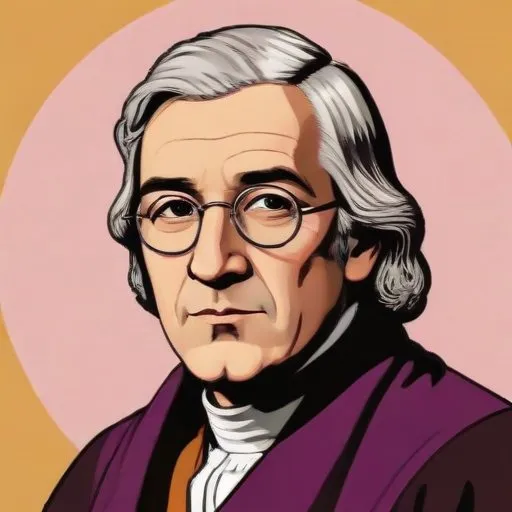
William Whiston: The Renowned English Theologian and Mathematician
A Pioneer in Popularizing Isaac Newton's Ideas
William Whiston is perhaps best known for his instrumental role in popularizing the groundbreaking ideas of Sir Isaac Newton, a leading figure in the scientific revolution of the 17th century. Whiston's tireless efforts to promote Newton's work not only furthered our understanding of the natural world but also paved the way for future scientific discoveries.
Early Life and Education
Born on December 9, 1667, in Nortonjuxta-Twycross, Leicestershire, England, Whiston was the son of Josiah Whiston, a rector, and Katherine Rosse. His mother was the daughter of the previous rector at Nortonjuxta-Twycross. Whiston's early education was marked by private tutoring due to his fragile health, which also led him to act as an amanuensis to his blind father. He later attended Queen Elizabeth Grammar School in Tamworth, Staffordshire, before entering Clare College, Cambridge, as a sizar in 1686.
Academic Achievements and Career
Whiston's academic prowess earned him a Bachelor of Arts degree in 1690 and a Master of Arts degree in 1693. He was elected Fellow in 1691 and probationary senior Fellow in 1693. In 1694, he resigned his tutorship at Clare College, citing ill health, and was ordained by William Lloyd at Lichfield in the same year.
Lucasian Professor of Mathematics and Controversies
Whiston's academic career reached new heights when he succeeded his mentor, Isaac Newton, as the Lucasian Professor of Mathematics at the University of Cambridge in 1702. However, his unorthodox religious views, particularly his rejection of the doctrine of the Trinity and eternal torment in hellfire, led to his expulsion from the university in 1710.
Translations and Literary Contributions
Whiston is also renowned for his translation of the
Antiquities of the Jews and other works by Josephus, which remain in print to this day. His book,
A New Theory of the Earth, presented a unique perspective on the natural world, blending science and theology.
The Longitude Act and its Implications
In 1714, Whiston played a key role in instigating the Longitude Act, which aimed to encourage innovation in navigation and cartography. Although he never won the rewards promised by the act, his efforts contributed significantly to the development of modern navigation.
Philosophical Contributions and Beliefs
Whiston's philosophical views were shaped by his Arianism, which rejected the notion of eternal torment in hellfire as absurd and cruel. He believed in the importance of reason and empirical evidence in understanding the natural world.
Legacy and Impact
William Whiston's remarkable life and work have left an indelible mark on the fields of theology, mathematics, and natural philosophy. His commitment to promoting scientific knowledge and his courage in challenging established beliefs continue to inspire future generations of scholars and thinkers.
- Antiquities of the Jews (translation)
- A New Theory of the Earth
Whiston's story serves as a testament to the power of human ingenuity, perseverance, and intellectual curiosity, reminding us that even in the face of adversity, we can achieve greatness through dedication and hard work.
FAQ
What was William Whistons occupation?
William Whiston was an English mathematician, historian, and theologian who taught at Cambridge University.
What was William Whistons most famous work?
William Whistons most famous work is his translation of Josephus The Antiquities of the Jews, which he translated into English and added extensive commentary.
What were William Whistons mathematical contributions?
William Whiston was a fellow of the Royal Society and made significant contributions to the field of mathematics, including the development of new methods for solving algebraic equations.
What was William Whistons religious views?
William Whiston was a Arian and was expelled from Cambridge University in 1711 for his unorthodox views on the Trinity.
What is William Whistons significance in English intellectual history?
William Whiston was a prominent figure in English intellectual history, making important contributions to mathematics, history, and theology, and engaging in public debates on religious and scientific topics.