


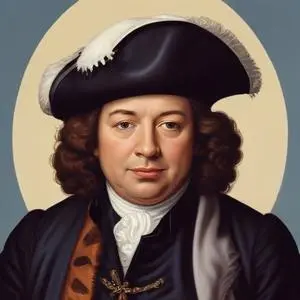
A 17th-century diarist and politician who chronicled his daily life, including significant historical events like the Great Fire of London, in a candid and detailed manner. His diary is a valuable historical resource and a window into the past.
Samuel Pepys is notoriously known for keeping a detailed and intimate diary that has become one of the most important primary sources for the English Restoration period. His diary, kept from 1660 to 1669, provides a unique blend of personal revelation and eyewitness accounts of significant events, including the Great Plague of London, the Second Dutch War, and the Great Fire of London.
He was educated at Huntingdon Grammar School and later at St Paul's School, London, where he developed a passion for learning and writing. In 1650, he went to the University of Cambridge, where he received two exhibitions.
Pepys' career in the Royal Navy began in 1660, when he was appointed as a clerk to George Downing, a Member of Parliament and a Teller of the Exchequer. He later became a Member of Parliament himself and served as the Chief Secretary to the Admiralty under both King Charles II and King James II.
Despite having no maritime experience, Pepys' talent for administration and his diligence earned him promotions and respect in the Royal Navy. He played a crucial role in the early professionalization of the Navy, introducing reforms and modernizing its administration.
Pepys' diary is a treasure trove of historical information, providing insights into the daily life of a 17th-century Englishman. It is a candid and intimate account of his feelings, experiences, and observations, covering topics such as politics, war, fashion, and entertainment.
The diary also includes eyewitness accounts of significant events, including the Great Fire of London in 1666, which Pepys witnessed firsthand. His detailed descriptions of the event have been invaluable to historians and researchers.
Samuel Pepys' diary has had a significant impact on modern society, influencing literature, history, and culture. His writings have inspired numerous adaptations, including stage plays, films, and radio dramas.
Pepys' contributions to naval administration and reform have also had a lasting impact on the Royal Navy, shaping its development and modernization.
"And so to bed," a phrase that concludes many of Pepys' diary entries, has become a iconic phrase in English literature.
Samuel Pepys lived during a tumultuous period in English history, marked by the English Civil War, the Restoration, and the Glorious Revolution. His diary provides a unique perspective on these events, offering insights into the daily life and experiences of people living during that time.
Pepys' legacy extends beyond his diary, with his contributions to naval administration and reform continuing to influence the Royal Navy to this day.
Born in 1632
A renowned 17th-century polymath who made groundbreaking contributions to physics, mathematics, and architecture, designing iconic landmarks like St Paul's Cathedral. Their innovative works continue to inspire and influence modern architecture and design.
Born in 1620
A 17th-century horticulturalist and writer who penned influential books on gardening, forestry, and architecture, shaping the English landscape and aesthetic. His works remain essential reading for garden enthusiasts and historians.
Born in 1627
Pioneering scientist who discovered Boyle's Law, which describes the relationship between pressure and volume of gases, and laid foundations for modern chemistry.
Born in 1656
Predicted celestial events, including the return of a comet that bears his name, and made significant contributions to navigation, astronomy, and mathematics.
Born in 1631
A dominant literary figure of the Restoration era, known for his influential poetry, plays, and critical essays that shaped the English literary landscape. He's often credited with creating a new style of heroic drama and satire.
