


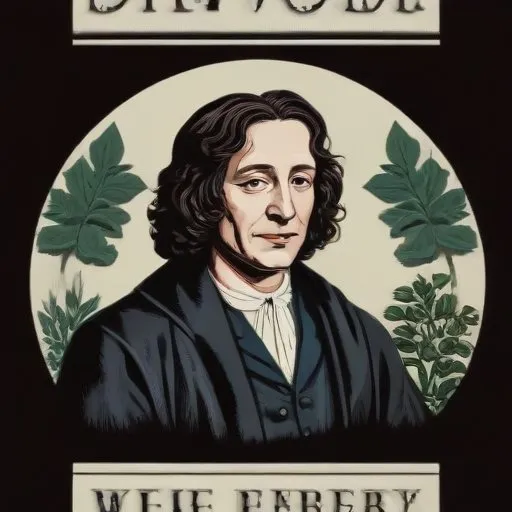
A 17th-century horticulturalist and writer who penned influential books on gardening, forestry, and architecture, shaping the English landscape and aesthetic. His works remain essential reading for garden enthusiasts and historians.
John Evelyn is best known for his remarkable diary, which spans 66 years and provides a vivid account of life in 17th-century England. As a writer, landowner, gardener, courtier, and minor government official, Evelyn's diary is a treasure trove of historical insights, covering significant events, cultural trends, and personal reflections.
Born on October 31, 1620, in Wotton, Surrey, Evelyn grew up in a family whose wealth was founded on gunpowder production. He spent his early years living with his grandparents in Lewes, Sussex, where he received his education at Lewes Old Grammar School. Evelyn refused to attend Eton College, instead opting for Balliol College, Oxford, and later the Middle Temple in London.
Evelyn's diary, which he kept from 1640 until his death in 1706, is an extraordinary document that offers a unique perspective on English history. The diary covers a wide range of topics, including art, culture, politics, and personal experiences. It provides valuable insights into significant events, such as the execution of Charles I, Oliver Cromwell's rise and fall, the Great Plague of London, and the Great Fire of London in 1666.
Evelyn's interests were diverse and far-reaching. He was a passionate gardener and wrote extensively on the subject. His book, Sylva, or A Discourse of Forest-Trees, published in 1664, was highly influential in encouraging landowners to plant trees. Evelyn believed that England was in danger of becoming deforested, and his work helped to raise awareness about the importance of reforestation.
John Evelyn's diary was first published posthumously in 1818, but it was later overshadowed by the diary of Samuel Pepys. However, Evelyn's work has continued to fascinate historians and scholars, providing a unique window into the past. His contributions to the fields of horticulture, forestry, and literature have had a lasting impact on English culture.
Evelyn married Mary Browne in 1647, and they had two sons. He was known for his strong friendships and connections with notable figures of the time, including King Charles II and the poet John Dryden.
John Evelyn's remarkable diary and his contributions to English culture have ensured his place in history. As a founding Fellow of the Royal Society, Evelyn played a significant role in the development of science and discovery in the 17th century. His work continues to inspire and educate, offering a fascinating glimpse into the life and times of a remarkable English Renaissance man.
Born in 1656
Predicted celestial events, including the return of a comet that bears his name, and made significant contributions to navigation, astronomy, and mathematics.
Born in 1633
A 17th-century diarist and politician who chronicled his daily life, including significant historical events like the Great Fire of London, in a candid and detailed manner. His diary is a valuable historical resource and a window into the past.
Born in 1632
A renowned 17th-century polymath who made groundbreaking contributions to physics, mathematics, and architecture, designing iconic landmarks like St Paul's Cathedral. Their innovative works continue to inspire and influence modern architecture and design.
Born in 1627
Pioneering scientist who discovered Boyle's Law, which describes the relationship between pressure and volume of gases, and laid foundations for modern chemistry.
Born in 1561
A 16th-17th century Renaissance figure who pioneered the scientific method and empiricism, and served as a prominent government official.
