


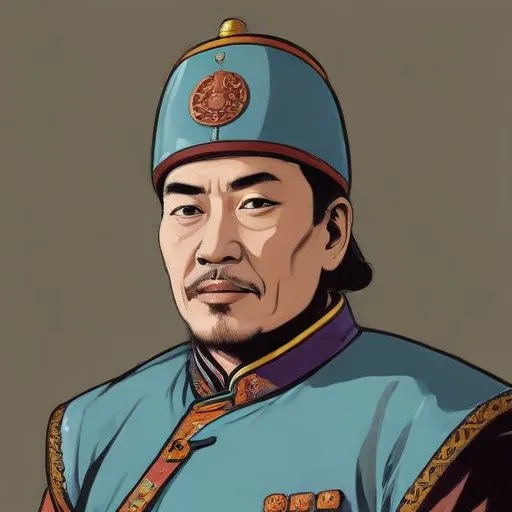
A powerful Chinese warlord and politician who dominated northern China during the Warlord Era, known for his military prowess and attempts to reunify the country.
Wu Peifu, a prominent warlord of the Republic of China, left an indelible mark on China's tumultuous early 20th century. As a master strategist and military leader, he navigated the treacherous landscape of warlordism, alliances, and rivalries, earning him the reputation as one of the most cunning and influential figures of his time.
Born on April 22, 1874, in Shandong Province, Eastern China, Wu Peifu received a traditional Chinese education before joining the Baoding Military Academy in Beijing. He quickly rose through the ranks, recognized for his exceptional talents as an officer. In 1902, he joined the New Army, later renamed the Beiyang Army, created by modernizing Qing dynasty Gen. Yuan Shikai.
Following the fall of the Qing dynasty in 1911, Wu became commander of the 6th Brigade. As the political landscape of China devolved into regional military authorities, Wu aligned himself with the Zhili Clique, led by Feng Guozhang. After Feng's death in 1919, Wu supported Cao Kun, who secured leadership of the Zhili Clique.
Wu's rise to prominence was marked by his cunning and strategic alliances. He clashed with rival warlords, including Duan Qirui's Anhui Clique, Zhang Zuolin's Fengtian Clique, and others. Wu's faction, along with the Zhili Clique, dominated politics in Beijing from 1916 to 1920. He pressured the president to dismiss Duan's key subordinate, Gen. Xu Shuzheng, paving the way for his own rise to power.
Wu Peifu's legacy is complex, marked by both his cunning and brutality. He played a significant role in shaping China's modern history, influencing the course of the Warlord Era, and impacting the lives of millions of Chinese citizens. While his methods were often ruthless, his strategic genius and adaptability earned him a place among the most important figures of his time.
Wu's impact on Chinese society and politics extends beyond his own lifetime. His legacy serves as a testament to the complexities and challenges of China's early 20th century, offering valuable lessons for future generations.
"A good general must be like a willow tree, flexible and resilient."
Wu Peifu's personal motto, reflecting his cunning and adaptability in the face of adversity.
Wu Peifu's rise to power coincided with the collapse of the Qing dynasty and the subsequent rise of warlordism. His career parallels that of other prominent warlords, including Duan Qirui, Zhang Zuolin, and Feng Yuxiang. While Wu's tactics were often ruthless, his strategic prowess and ability to navigate complex alliances set him apart from his contemporaries.
Wu's legacy serves as a reminder of the tumultuous nature of China's early 20th century, marked by war, instability, and the struggle for power. His story offers a unique perspective on the era, shedding light on the intricate web of alliances and rivalries that shaped the course of Chinese history.
Born in 1859
A Chinese general and politician who rose to become the first president of the Republic of China, known for his role in ending the Qing dynasty and establishing a new government. He's also infamous for his attempts to restore the monarchy with himself as emperor.
Born in 1865
A Chinese warlord and politician who dominated Beijing's government during the Warlord Era, known for his attempts to reunify a fragmented China through military campaigns and political maneuvering.
Born in 1887
Led the Nationalist Party in China, fighting against the Communist Party and later establishing the government of Taiwan. He's known for his role in shaping modern Chinese history.
Born in 1866
A Chinese revolutionary who led the overthrow of the Qing dynasty and founded the Republic of China, known for his role in shaping modern China's government and politics.
