


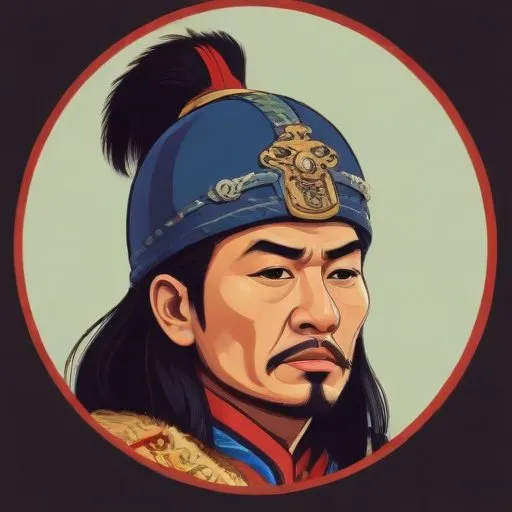
A powerful Chinese warlord who ruled Manchuria and briefly held control of the Beijing government, known for his struggle against Japanese and Communist forces.
Zhang Zuolin, a Chinese warlord, ruled Manchuria with an iron fist from 1916 to 1928, making him one of the most dominant figures of the Warlord Era. As the leader of the Fengtian clique, he controlled the three northeastern provinces of Fengtian, Jilin, and Heilongjiang, and briefly installed himself as President of the Republic of China in the last year of his life.
Born on March 19, 1875, to a poor peasant family in Manchuria, Zhang Zuolin's early life was marked by hardship and strife. At the age of twenty, he enlisted as a cavalry soldier to fight in the First Sino-Japanese War (1894-1895). After the war, he returned to his hometown and became a bandit, forging close relationships with figures who would later occupy important positions in his military clique.
In 1903, Zhang's bandit gangs joined the regular army, and after the Russian-Japanese War, his forces retained the ambiguous characteristics of a regular military unit and an outlaw gang. This unique blend of power and influence allowed him to play a prominent role in the 1911 Revolution in Fengtian, and in 1916, he was appointed Fengtian's Civil and Military Governor.
By 1919, Zhang had already taken control of the three northeastern provinces, and by the beginning of 1925, he had become the most powerful military leader in northern China. He controlled these territories until his death in 1928 as commander-in-chief of the Fengtian clique, which grouped his supporters.
Zhang's vast resources, obtained from the exploitation of Manchuria's natural riches, enabled him to influence national politics. However, his dominance was eventually targeted by the Kuomintang's Northern Expedition in 1926, directed against the Beiyang government dominated by him.
Zhang Zuolin's legacy is complex and multifaceted. While his rule was marked by brutality and corruption, he also played a significant role in shaping modern Chinese politics and history. His influence can still be seen in the region he once controlled, and his life serves as a cautionary tale about the dangers of unchecked power and ambition.
Born in 1887
Led the Nationalist Party in China, fighting against the Communist Party and later establishing the government of Taiwan. He's known for his role in shaping modern Chinese history.
Born in 1866
A Chinese revolutionary who led the overthrow of the Qing dynasty and founded the Republic of China, known for his role in shaping modern China's government and politics.
Born in 1874
A powerful Chinese warlord and politician who dominated northern China during the Warlord Era, known for his military prowess and attempts to reunify the country.
Born in 1865
A Chinese warlord and politician who dominated Beijing's government during the Warlord Era, known for his attempts to reunify a fragmented China through military campaigns and political maneuvering.
Born in 1901
A Chinese warlord who controlled Manchuria and played a crucial role in the Chinese Civil War, known for his role in the Xi'an Incident, a pivotal event in modern Chinese history.
Born in 1883
A Chinese politician who led a Japanese-backed puppet government in China during World War II, known for his controversial role in collaborating with the enemy.
