


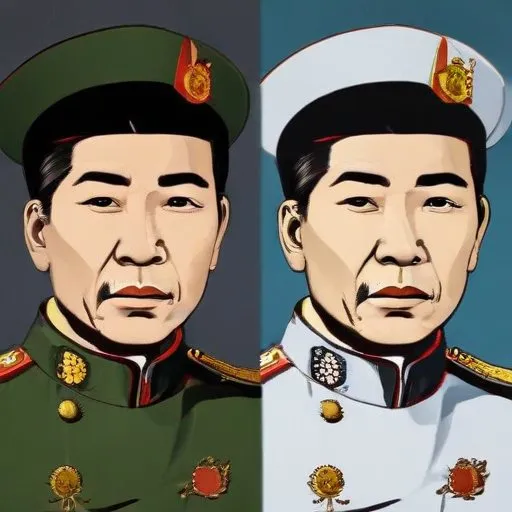
A Chinese warlord who controlled Manchuria and played a crucial role in the Chinese Civil War, known for his role in the Xi'an Incident, a pivotal event in modern Chinese history.
Zhang Xueliang, also known as Peter H. L. Chang, was a Chinese warlord who ruled Manchuria from 1928 to 1936 and played a crucial role in the reunification of China during the Warlord Era. He is best known for his pivotal role in the 1936 Xian Incident, which led to the formation of the Second United Front against Japan.
Zhang Xueliang was born on June 3, 1901, in Haicheng, Liaoning province. He was educated by private tutors and showed a keen interest in Western culture, which set him apart from his father, the warlord Zhang Zuolin.
Zhang graduated from Fengtian Military Academy and quickly rose through the ranks, becoming a colonel in the Fengtian Army and commander of his father's bodyguards in 1919. He was sent to Japan in 1921 to observe military maneuvers, where he developed a fascination with aircraft and later established an air corps for the Fengtian Army.
Zhang Xueliang was a reformer at heart, sympathetic to nationalist ideas and eager to modernize Manchuria. He completed the official reunification of China by pledging loyalty to the Nationalist government in Nanjing, but he retained Manchuria's de facto autonomy until the Japanese invasion in 1931.
Frustrated with Chiang Kai-shek's policy of "first internal pacification, then external resistance," Zhang helped plan and lead the 1936 Xian Incident, in which Northeastern soldiers under his command arrested Chiang to force him to negotiate a Second United Front with the Chinese Communist Party against Japan.
Chiang eventually agreed to the Second United Front, but upon his release, he had Zhang arrested and sentenced to 50 years of house arrest, first in mainland China and then in Taiwan. Despite being a non-communist, Zhang is regarded as a patriotic hero by the Chinese Communist Party and the People's Republic of China for his role in ending the encirclement campaigns and beginning the war of resistance against Japan.
Zhang Xueliang was known for his charitable work and social contributions. He was a patron of education and supported several schools and universities in Manchuria. Despite his tumultuous life, he remained committed to his country and people, earning him the respect and admiration of his contemporaries.
Zhang Xueliang's legacy extends far beyond his military achievements. He played a crucial role in shaping modern China and is remembered as a patriotic hero who fought against Japanese aggression. His life serves as a testament to the complexities and challenges of China's tumultuous 20th century.
Born in 1887
Led the Nationalist Party in China, fighting against the Communist Party and later establishing the government of Taiwan. He's known for his role in shaping modern Chinese history.
Born in 1893
Leader of the Chinese Communist Party who implemented radical social and economic reforms, including the Great Leap Forward and the Cultural Revolution, shaping modern China's politics and economy.
Born in 1886
A prominent Chinese military leader and politician who played a crucial role in the Chinese Civil War and the establishment of the People's Republic of China, serving as the second-in-command to Mao Zedong. He's most known for his military strategies and leadership during the war.
Born in 1898
A prominent military leader who played a crucial role in the Chinese Civil War and later became a key figure in the Communist Party, known for his criticisms of Mao's policies. He was eventually purged and persecuted during the Cultural Revolution.
Born in 1896
A prominent Chinese military leader and politician who played a key role in the Chinese Civil War and later served as the 1st Vice Premier of the People's Republic of China, known for his efforts in modernizing the Chinese military. He was a close ally of Mao Zedong and helped establish the People's Liberation Army.
Born in 1907
A powerful Chinese military leader and politician who rose to prominence during the Chinese Civil War and later became a close ally of Mao Zedong, playing a crucial role in the Cultural Revolution. He is infamous for his alleged plot to overthrow Mao and his mysterious death in a plane crash.
Born in 1883
A Chinese politician who led a Japanese-backed puppet government in China during World War II, known for his controversial role in collaborating with the enemy.
Born in 1893
Honorary President of the People's Republic of China, a prominent figure in modern Chinese history, known for her key role in the country's revolution and her marriage to Sun Yat-sen.
