


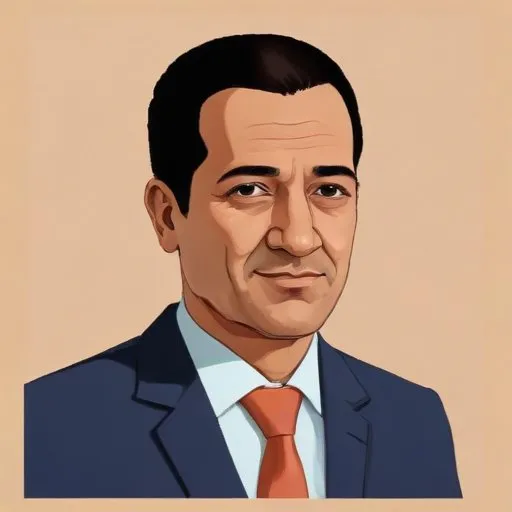
Egyptian-Turkish journalist, author, and politician who wrote influential novels and essays on Turkish identity and culture, and served as a diplomat and politician in both Egypt and Turkey.
Yakup Kadri Karaosmanoğlu is renowned for his multifaceted career as a Turkish novelist, journalist, diplomat, and member of parliament. Through his writings and public service, he left an indelible mark on Turkey's literary and political landscapes.
Born on March 27, 1889, in Cairo, Egypt, Yakup Kadri was the son of Abdul Kadir Bey, a member of the esteemed Karaosmanoğlu family, which originated in the Manisa region of Turkey. His mother, Kıbal Hanım, was a lady-in-waiting in Ismail Pasha's palace community.
After spending his early childhood in Cairo, Yakup Kadri's family moved to Manisa, where he received his primary education. In 1903, the family relocated to İzmir, further enriching his cultural and educational experiences.
Yakup Kadri's literary career began in 1913, with the publication of his first work. However, it was his novel Yaban (Stranger), published in 1932, that cemented his reputation as a prominent Turkish writer. This seminal work tells the story of Ahmed Celal, a Turkish intellectual who loses his arm in the Battle of Gallipoli and subsequently struggles to adapt to rural life.
Yaban is often categorized as a naturalist novel, offering a poignant portrayal of the human experience during times of war and social change. Through his writing, Yakup Kadri provided a voice for the Turkish people, exploring themes of identity, culture, and the human condition.
Yakup Kadri's political career spanned several decades, during which he served in various capacities. He was a member of the Turkish Grand National Assembly from 1931 to 1934, representing his hometown of Manisa. He also played a key role in the establishment of the Turkish Republic in 1923, contributing to the country's early development.
In the 1930s, Yakup Kadri founded and edited the newspaper Tan, a prominent publication that helped shape public opinion during a tumultuous period in Turkish history. He later served as Turkey's ambassador to various European and Middle Eastern capitals, further solidifying his diplomatic credentials.
Throughout his life, Yakup Kadri Karaosmanoğlu received numerous accolades for his literary and diplomatic contributions. He was elected chairman of the Anadolu Agency in 1966, a testament to his enduring influence in Turkish media and politics.
Yakup Kadri passed away on December 13, 1974, at the Gülhane Military Medical Academy in Ankara. He was laid to rest beside his mother's tomb in Yahya Efendi Cemetery, Istanbul.
Today, Yakup Kadri's legacy extends beyond his remarkable body of work. He remains an inspiration to generations of Turkish writers, diplomats, and politicians, embodying the ideals of public service, literary excellence, and cultural stewardship.
Born in 1873
A Turkish poet, academic, and politician who played a significant role in shaping the country's literary and political landscape, best known for writing the Turkish national anthem.
Born in 1881
Founder of modern Turkey, leading the country's transition from the Ottoman Empire to a secular, democratic nation, and implementing sweeping reforms in education, law, and women's rights.
72 Years Old
The 12th President of Turkey, a dominant figure in Turkish politics, known for his Islamist roots and authoritarian leadership style, shaping Turkey's modern political landscape.
Born in 1840
A Turkish journalist, playwright, and activist who championed liberal reforms and Turkish nationalism through his writings, inspiring a generation of Ottoman intellectuals.
