


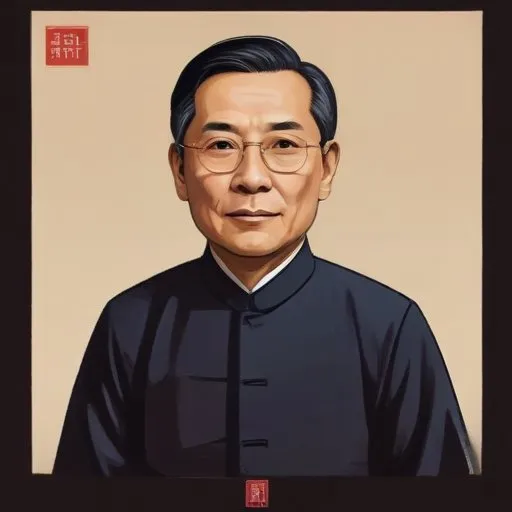
A Chinese lawyer and politician who served as the President of the Republic of China from 1975 to 1988, known for his efforts to modernize Taiwan's economy and strengthen its international relations.
Yen Chiakan, also known as C. K. Yen, was a Chinese chemist-turned-politician who played a pivotal role in shaping Taiwan's economy and politics in the mid-20th century. He is best known for serving as the 2nd President of the Republic of China, succeeding Chiang Kai-shek, and overseeing the country's economic transformation during his presidency from 1975 to 1978.
Yen was born on October 23, 1905, in Mudu, Wu County, Jiangsu province, China, into the prestigious Yan Yen Family of Dongshan. He graduated from Saint John's University in Shanghai with a degree in chemistry in 1926, laying the foundation for his future career in politics and economics.
Yen's political career began in 1931, when he served as a manager of the Shanghai railway administration. He then worked as the director of the finance department of Fujian Provincial Government in 1938, where he initiated a policy of land tax payment for farmers with their agricultural produce. This innovative policy was later adopted nationwide across China, contributing significantly to the country's food supply during World War II.
In 1945, Yen arrived in Taiwan and was appointed transportation director for the Taiwan Provincial Government. He later served as provincial finance director and chairman of the Bank of Taiwan, earning the nickname "father of the New Taiwan dollar" for his role in introducing the new currency in 1949.
Yen's political career continued to flourish as he served as Minister of Economic Affairs, Minister of Finance, and Governor of Taiwan Province. He became premier in 1963 and was elected Vice President in 1966, re-elected in 1972. As Vice President, Yen was the most senior government official to travel abroad, representing the Republic of China on the international stage.
After Chiang Kai-shek's death in 1975, Yen succeeded him as the President of the Republic of China, serving until 1978. During his presidency, Yen continued to drive Taiwan's economic growth, focusing on infrastructure development, industrialization, and trade liberalization. His leadership played a crucial role in transforming Taiwan into one of the "Four Asian Tigers," a group of highly industrialized economies in East Asia.
Yen's legacy extends beyond his political achievements. He was a strong advocate for education and played a key role in establishing several universities in Taiwan. He was also a proponent of social welfare and introduced policies to improve the lives of Taiwan's citizens.
Yen passed away on December 24, 1993, leaving behind a legacy as one of Taiwan's most influential politicians and economists. His commitment to public service and his vision for Taiwan's development continue to inspire future generations of leaders and citizens alike.
Despite his many achievements, Yen remained humble and dedicated to his country throughout his life. As he once said, "I am just a simple man who has tried to do his best for his country."
Yen's presidency and economic reforms have been featured in various documentaries, films, and books on Taiwan's history and development. His legacy continues to be celebrated in Taiwan and beyond, serving as a testament to his enduring impact on the country's politics, economy, and society.
Born in 1887
Led the Nationalist Party in China, fighting against the Communist Party and later establishing the government of Taiwan. He's known for his role in shaping modern Chinese history.
Born in 1897
Vice President of the Republic of China from 1954 to 1965, known for his role in Taiwan's government and diplomatic efforts during the Cold War era.
Born in 1866
A Chinese revolutionary who led the overthrow of the Qing dynasty and founded the Republic of China, known for his role in shaping modern China's government and politics.
Born in 1883
A Chinese politician who led a Japanese-backed puppet government in China during World War II, known for his controversial role in collaborating with the enemy.
