


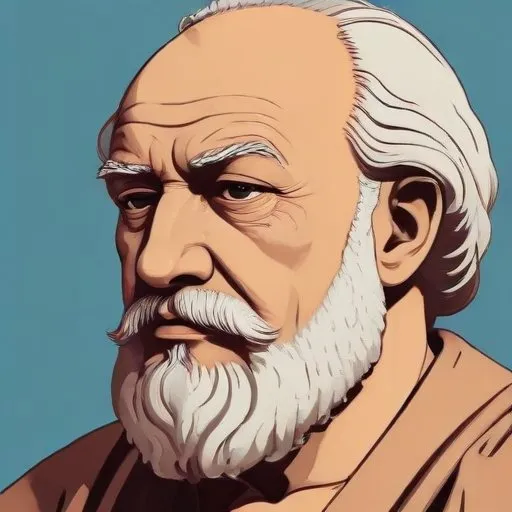
A celebrated Greek poet and playwright, known for his powerful and evocative works that often explored themes of love, politics, and the human condition. His poetry is characterized by its lyricism and accessibility.
Yiannis Ritsos, a renowned Greek poet and communist, is best known for his powerful and poignant works that captured the essence of the human experience during times of war, resistance, and social change. His poetry, infused with a deep sense of social consciousness and political activism, has earned him the title of "the great poet of the Greek left."
Ritsos' life was marked by tragedy and hardship from an early age. Born into a wealthy landowning family in Monemvasia, Greece, he suffered the loss of his mother and eldest brother to tuberculosis, and his father struggled with mental illness. The family's economic stability was also shattered, leaving Ritsos with emotional scars that would later influence his poetry.
In 1934, Ritsos joined the Communist Party of Greece (KKE) and began to develop his literary voice. His first notable work, "Tractor," was published the same year, followed by "Pyramids" in 1935. These early poems revealed Ritsos' unique blend of communist ideology and personal despair, which didn't resonate with leftist critics who found his language too ornate.
In 1936, Ritsos was inspired by a photograph of a dead protester during a tobacco workers' demonstration in Thessaloniki. This event sparked the creation of his iconic poem, "Epitaphios," which broke with traditional Greek poetry forms and expressed a powerful message of unity and solidarity. Though it was publicly burned by the right-wing dictatorship of Ioannis Metaxas, "Epitaphios" cemented Ritsos' status as a voice for the oppressed.
In response to the political repression, Ritsos embarked on a new creative journey, delving into the realm of surrealism. He began to experiment with dreams, associations, and imagery, crafting a unique lyrical style that reflected the anguish and uncertainty of the times.
Throughout his life, Ritsos remained dedicated to his craft, producing a vast oeuvre that continues to captivate readers and inspire new voices. His poetry is a testament to the power of art to challenge, provoke, and uplift, earning him a revered place in the annals of Greek literature.
Born in 1911
A Greek poet and critic, renowned for his lyrical and evocative works that explored the human experience, mythology, and the Greek identity. His poetry is celebrated for its musicality and depth.
Born in 1900
A Greek poet and diplomat who won the Nobel Prize in Literature in 1963 for his lyrical and symbolic poetry that explored Greek identity and culture. His work is known for its evocative and introspective style.
Born in 1863
A renowned poet and journalist who crafted evocative, historically-inspired verses that probed the human condition, exploring themes of love, identity, and mortality. His unique style blended ancient and modern elements, earning him a devoted following.
Born in 1883
A Greek philosopher, author, and playwright who explored the human condition through novels like "Zorba the Greek" and "The Last Temptation of Christ", delving into themes of spirituality, morality, and individualism.
Born in 1884
A leading figure in the Greek literary revival of the 20th century, known for blending folk traditions with modernist experimentation in his poetry and plays. His work explores themes of identity, mythology, and the human condition.
Born in 1859
A leading figure of the Greek literary generation of the 1880s, he wrote influential poetry and plays that explored themes of Greek identity and national revival. His works are considered cornerstones of modern Greek literature.
Born in 1904
A Chilean poet and diplomat who wrote passionate and evocative poetry that explored love, politics, and the human condition, and was awarded the Nobel Prize in Literature in 1971.
Born in 1898
A Spanish poet, playwright, and director who explored themes of love, death, and Spanish culture through his works, including the famous play "Blood Wedding".
