


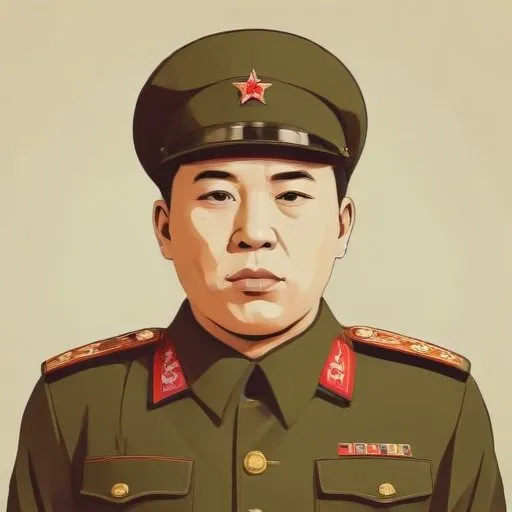
A high-ranking North Korean official who served as Premier from 1988 to 1992, known for his role in shaping the country's economic policies during a period of significant reform. He was a key figure in the Kim Il-sung regime.
Yon Hyongmuk, a veteran politician and statesman, is best known for his pivotal role in shaping North Korea's relations with South Korea during the late 20th century. As the Prime Minister of North Korea from 1988 to 1992, Yon was instrumental in forging the Agreement on Reconciliation, Nonaggression, and Exchanges and Cooperation between the South and the North, also known as the South-North Basic Agreement of 1991, a landmark accord that marked a significant milestone in inter-Korean relations.
Born on November 3, 1931, in Kyongwon County, Kankyohoku, Korea, under Japanese colonial rule (now in North Hamgyong Province, North Korea), Yon came from a family with a strong revolutionary background. After receiving his education locally, he worked as a farm worker before pursuing further studies in Czechoslovakia. By the 1950s, he had firmly established himself within the hierarchy of the Workers' Party of Korea.
In 1967, Yon was selected as a deputy to the Supreme People's Assembly, marking the beginning of his rapid ascent within the Party ranks. During the 1970s, he further advanced in the Party, and by the mid-1980s, he was regarded as the fourth most powerful person in North Korea, after Kim Il-sung, Kim Jong-il, and veteran marshal and defense minister O Jin-u.
In 1989, Yon became the Prime Minister of North Korea, consolidating his role in the country's large armaments sector as Minister of Heavy Industry. As Prime Minister, he played a crucial role in relations between North and South Korea, earning recognition as the chief negotiator behind the South-North Basic Agreement of 1991. This agreement, hailed as the "most valuable achievement ever made between the South and North Korean authorities," marked a significant breakthrough in inter-Korean relations.
Throughout the 1990s, Yon remained a key figure in North Korea's efforts to reconcile with South Korea. Despite his declining health in the 2000s, his legacy as a champion of inter-Korean cooperation continued to inspire generations of Korean leaders. Yon's unwavering commitment to reconciliation has left an indelible mark on the Korean peninsula, cementing his place as one of the most influential figures in modern Korean history.
Yon Hyongmuk's legacy extends beyond the realm of politics. His tireless efforts to reconcile North and South Korea have inspired generations of Koreans, fostering a sense of unity and cooperation in the face of division. As a symbol of hope and reconciliation, Yon's life and work continue to inspire Koreans and non-Koreans alike, serving as a beacon of peace and cooperation in a tumultuous world.
Born in 1926
A South Korean politician who served as Prime Minister and played a key role in the country's economic development and democratization. He's also known for his involvement in the Gwangju Democratization Movement.
95 Years Old
The Premier of North Korea from 2010 to 2013, known for implementing economic reforms and improving relations with South Korea. Held significant power in the isolated nation's government.
