


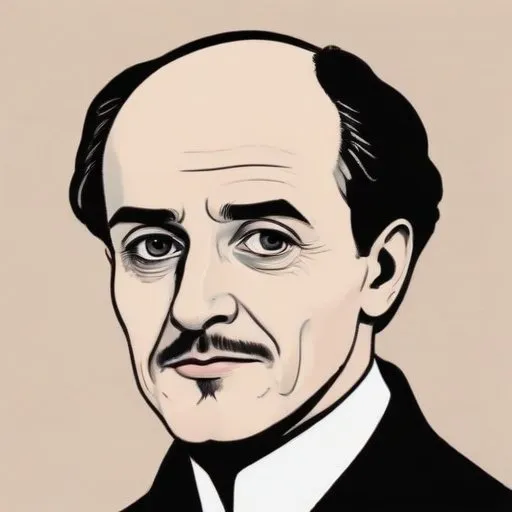
A French-German poet and playwright who blended surrealism and expressionism, creating a unique style that explored the human condition. His works often featured fantastical and dreamlike elements.
Yvan Goll, the renowned French-German poet, left an indelible mark on the literary world by bridging the gap between German Expressionism and French Surrealism. Through his work, he not only reflected the tumultuous times he lived in but also forged a unique path that continues to inspire generations of writers and artists.
Born Isaac Lang on March 29, 1891, in Alsace-Lorraine, Goll's life was a tapestry of cultural fusion. His father, a cloth merchant from a Jewish family in Rappoltsweiler, Alsace, instilled in him a love for languages, while his mother's relatives in Metz, Lorraine, introduced him to the richness of French culture. This bilingual upbringing would later become the cornerstone of his poetic identity.
Goll's early years were marked by a deep fascination with German Expressionism. He studied law at the universities of Strasbourg, Freiburg, and Munich, graduating in 1912. It was during this period that he became acquainted with the works of Expressionist poets, which would later shape his own writing style. His first notable poem, "Der Panamakanal" (The Panama Canal), showcased his ability to balance the tragic with the optimistic, setting the tone for his future works.
The outbreak of World War I saw Goll escape to Switzerland to avoid conscription. It was in Zurich that he befriended the Dadaists, including Hans Arp, Tristan Tzara, and Francis Picabia, at the famed Cabaret Voltaire. This exposure to Dadaism's anti-war sentiment and absurdity would influence his poetry, as seen in his 1916 masterpiece, "Requiem for the Dead of Europe."
In 1917, Goll met Klara Aischmann, a German writer and journalist, who would become his wife and collaborator, Claire Goll. Together, they settled in Paris in 1919 and married in 1921. Claire's presence in his life not only brought emotional stability but also inspired some of his most remarkable works, including the play "The Immortal One" (1918).
Through his essays, such as "Die drei guten Geister Frankreichs" (The Three Good Spirits of France), Goll advocated for a deeper understanding between the people of France and Germany. His efforts were a beacon of hope during a time of great turmoil, highlighting the importance of cultural exchange and cooperation.
Yvan Goll's poetry and plays continue to captivate audiences with their unique blend of French and German sensibilities. His work serves as a testament to the power of cultural fusion, inspiring future generations to build bridges between nations and artistic movements. As we reflect on his life and legacy, we are reminded of the transformative power of poetry to bring people together in the face of adversity.
Born in 1896
French poet and author who founded Surrealism, a cultural movement that explored the subconscious and the world of dreams. He wrote novels, poems, and essays that continue to influence art and literature today.
Born in 1897
A leading figure of the French Resistance during WWII, he wrote influential poetry and novels that explored the human condition, blending politics and art.
Born in 1889
A renowned French creative force, celebrated for his innovative and surreal works that blurred the lines between literature, art, and cinema, leaving an indelible mark on 20th-century culture.
Born in 1880
An Italian-French literary genius who pioneered Cubist poetry, blending fragmented images and multiple narratives to create a new kind of lyrical expression. His work influenced the development of Surrealism and modern art.
Born in 1899
A Belgian-French poet and painter who explored the subconscious through automatic writing and vibrant, abstract art, blending words and images to evoke emotions and inner experiences.
Born in 1907
A French poet and author who blended surrealism with resistance poetry, known for his lyrical and symbolic works that explored the human condition during World War II.
